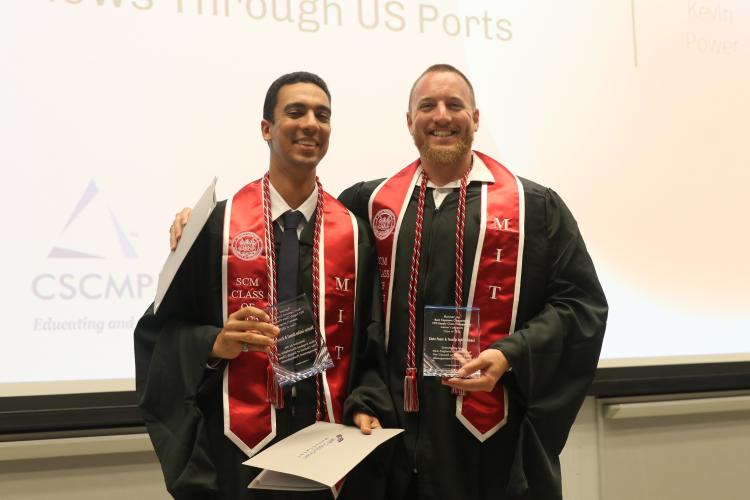
MIT SCM’25 Students Yassine Lahlou-Kamal (left) and Kevin Power (right)
As a college student, Kevin Power never considered working in supply chain management; in fact, he didn’t know it was an option. He earned an undergraduate degree in manufacturing engineering while working full-time at an oil refinery, which demanded a rigorous routine of shift work, long days, and evening classes.
After graduation, he found himself searching for new learning opportunities, and stumbled upon the online courses of the MITx MicroMasters® Program in Supply Chain Management. Starting with Supply Chain Analytics: SC0x, Power was drawn in immediately by how directly applicable the lessons were to real work. “So many courses that you do are more theoretical,” he reflects. “Everything I learned, I could apply it directly to my work and see the value in doing it. So as soon as I finished Supply Chain Analytics, I decided, okay, I’ll finish the whole program.” What he didn’t yet know was that he belonged to the very audience the MicroMasters was designed for—life-long learners. Learners are often working professionals who want deep, flexible training while continuing their careers.
After completing the five-course MicroMasters track and earning his credential, Power uncovered another opportunity: the MIT SCM Blended Master’s Program, which pairs the online credential with a one-semester, on-campus program, resulting in a Master of Applied Science in Supply Chain Management.
For Power, the blend of online and in-person learning proved pivotal. He describes his MicroMasters experience as fertile ground for deep, self-paced study. “I’m a very introverted kind of learner, so I prefer to just learn out of a textbook and online,” he says. But, once in the MIT SCM program, he tapped into the soft skills he needs to stand out in the industry. “When I came to campus, it was more about networking and being able to communicate with executives, on top of our academic work,” he says. The immersive environment of combining scholarly rigor with real-world experience among peers across the supply chain industry is at the heart of what the blended program aims to facilitate.
During his time on campus, Power’s research included simulation modeling in port shipping and generative-AI–driven projects focused on supply chain resilience. “I had never done simulation modeling before, and right now it’s huge in the industry,” he says. “If I were trying to apply for a simulation modelling job, I’m sure it would help me greatly having done this.” His project, completed with fellow MIT SCM student Yassine Lahlou-Kamal, was one of the winners at the 2025 Annual MIT Global SCALE Network Supply Chain Student Research Expo, in which students showcased their industry-sponsored thesis and capstone projects. This experience pays off in his current work with Dr. Elenna Dugundji in her Deep Knowledge Lab for Supply Chain and Logistics.
Beyond academics and research, Power threw himself into the fast-paced world of hackathons, despite having never participated in one before. “I’m very competitive,” Power confesses, “and I feel like I learn something new every time.” His first effort, an internal MIT competition called Hack-Nation’s Global AI Hackathon, earned him a win with an AI sports-betting agent project that fuses model-driven analysis with web scraping. Soon after, he tackled the OpenAI Red Teaming Challenge on Kaggle. Despite joining the competition halfway through the 15-day window, he raced through the final week and was selected as one of the winners. “It gave me a lot of confidence…that the things I’m working on right now are cutting-edge even in the eyes of OpenAI.”
In terms of his return on investment in the degree, Power says, “I’m getting so much value out of being here. Even from just doing the Kaggle competition, I won more than the cost of my full MIT degree.” Long-term, Power has been impressed that “as far as I know, everybody that was looking for a job in the supply chain program has one.” The data backs him up, as every student from the MIT SCM residential program Class of 2025 secured a job within six months of graduation.
Looking ahead, Power says, “I want to do a startup. A lot of the ideas came from research I’ve done here.” Reflecting on the transformation he’s experience in just 10 months of the program, he calls it “crazy.” “The SCM program really is amazing…I’d recommend it to anyone.”