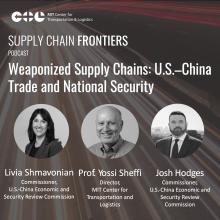
Rising geopolitical tensions and global trade volatility have revealed a key power struggle: supply chains are a matter of national security. This year’s annual report from the congressional U.S.–China Economic and Security Review Commission warns that China has begun weaponizing key supply chain chokepoints, from critical minerals to foundational semiconductors, creating risks that reach far beyond trade.
In this episode, we’re joined by Livia Shmavonian and Josh Hodges, two commissioners of the U.S.–China Economic and Security Review Commission, along with Professor Yossi Sheffi, Director of the MIT Center for Transportation and Logistics. They discuss key findings from this year’s report: why companies have been slow to recognize the strategic nature of their dependence on China, how subsidies and overcapacity distort global competition, and why innovation remains the United States’ greatest advantage. From U.S. manufacturing limitations to critical mineral processing to market access in China, the conversation explores what’s at stake, what must change, and how companies and policymakers can prepare for a future where supply chain strategy is inseparable from national security.
You can read the full report here.
Transcript
- Welcome to another episode of "Supply Chain Frontiers," the MIT CTL podcast where we explore the trends, technologies, and innovations shaping the future of supply chain management. I'm your host, Mackenzie Berry. Today we're diving into the US-China economic and trade relationship. Joining us are the director of the MIT Center for Transportation and Logistics, professor Yossi Sheffi, and two commissioners from the U.S.-China Economic and Security Review Commission, Livia Shmavonian and Josh Hodges. Here's what I know. The U.S.-China Economic and Security Review Commission is a legislative branch commission created and mandated by Congress to report on and provide policy recommendations regarding how the bilateral trade and economic relationship between the United States and China affects US national security. Every year the commission publishes a report which makes policy recommendations for congressional action. This year the report is based on six public hearings the commission conducted, taking testimony from 50 expert witnesses from government, the private sector, academia, think tanks, and research institutions. In this episode two commissioners share their insights from the report in conversation with Professor Yossi Sheffi, an expert in systems optimization, risk analysis, and supply chain management. Welcome, everyone. If we could just go around and introduce ourselves.
- I'm Yossi Sheffi. I'm a professor of engineering systems at MIT and the director of the MIT Center for Transportation Logistics, which does the supply chain management work.
- Josh Hodges, I'm a commissioner on the US-China Commission. And before this I was National Security Advisor to Speaker of the House, Mike Johnson, and have a background in intelligence, foreign policy, and international affairs.
- Hi all, thanks for having us. Livia Shmavonian. I'm also a commissioner on the US-China Commission. Prior to this role I was director of the Made in America Office at the White House under President Biden, and served Senator Bob Casey. I'm a trade and economic policy expert.
- So glad to have you all. So to dive right into the report, setting the stage on the US-China economic and trade relations, the report opens with an observation about new US and other tariffs on Chinese exports, and how they've exposed interconnected nature of supply chains for critical technologies. How should policymakers interpret that interconnection? Is it a vulnerability, is it a leverage point or both?
- Yeah, that's a great question. It's both. It is a massive vulnerability for the United States. It's something that the China Commission has discussed for many, many years, and we also explored during this report cycle. We have seen over and over and over again the risks associated with being highly dependent on specific manufacturers and specific countries for critical inputs to our supply chains: critical minerals, semiconductors, pharmaceuticals, ICTS, transformers, the list goes on and on. And we have seen the Chinese government increasingly ratchet up pressure related to those strategic choke points that they know they hold and we know they hold. It is a risk, it is a point of leverage that the Chinese government can hold against us, but also against our allies and partners, which is another element that we explored, and we have seen borne out most recently with respect to the aggressive action that China threatened related to critical minerals and supply of critical minerals.
- So I would completely agree. It is absolutely a vulnerability and a leverage point for China and to their benefit. The most important aspect of where we are is that I think people beyond the policy wonks have woken up to reality. And unfortunately, waking up is only half the battle. China has achieved its supply chain chokehold using manufacturing surplus, dumping subsidies to distort global trading system. That's been going on for a long, long time. But folks are finally starting to pay attention to it, to see how that chokehold can be used to better position Chinese in these types of negotiations and potentially some of the long-term implications there. There's ample evidence the commission has uncovered over the past few years that shows manufacturers operating abroad are beholden to the Chinese Communist Party's interests. And we've identified ample information about the CCP companies operating in third-party countries that are working to increase their industrial space to outcompete American interest here. And so one of the things we are looking at this year is how the CCP is really starting to put this campaign to achieve dominance. And we've seen from testimony this year that the Chinese market share in products and relevant technologies is staggering. In solar panels, they've got 80% of the market share; mobile phones, they've got 50% of the market share; electric vehicles, display panels. We've also been uncovering data that suggests that they're looking to beyond existing technology and into future technology. And so this all ties back to the fact that they are looking to use this as a leverage point as things continue to move forward.
- The report also describes rising economic tensions colliding with concerns over China's technological prowess. To what extent do you see the collision as primarily economic and to what extent is it strategic or security-driven?
- I absolutely think this is starting as economic. And I think one of the major problems we've had over the past 15 years, getting people to pay attention here, is that there has been an intentional effort to paint this as business competition, not as a national security issue and not as sort of a economic security issue. And again, I think folks are finally starting to wake up to that, recognizing that all of this is linked together. It's not just economic tensions, but that this ultimately is going to have an impact to the United States and our longevity in the long term from a business sense but also a national security sense.
- Pulling back, China's a communist country. And to Josh's point, there has been a lot of discussion. And I have been in a lot of rooms and I'm sure Josh has as well, where folks talk about this as business competition. It's business competition with a communist country that has command and control over their factors of production. And whether or not they choose to leverage those is a question. But the question as to whether they could is not open. They can, they have, they will, and the Chinese government will continue to do that. I think another important element is recognizing that while the United States and our allies and partners might view economic competition and national security goals as separate, the Chinese government does not. They view those two elements together and alongside each other, and one can be a point of leverage towards the other. And in furtherance of the other, we have seen China, the Chinese government tell their population to stop buying products from certain firms, and they do. They stop buying products from certain firms. One of the greater sleight of hands or tricks that China has accomplished in my view is making firms believe that they have power in the Chinese market, and they don't. The Chinese government can shut that off when they so choose.
- Absolutely, if I could just add something onto that, in addition to being communists, there's a sort of trickle-down effect of that, and this gets back to values. and the Chinese are actively building a market on the backs of slave labor related to Uyghurs, and they're doing it with the intent of global domination. So this isn't just a matter of do you think our way of living or their way of living is better, is do you agree with how they're going about building what they're building? And that's a question that I think businesses should be asking more regularly and that consumers should be asking the businesses.
- And Yossi, turning to you, in terms of tariffs, which you've written extensively about, one recommendation you offer to companies in your recent article in "MIT Sloan Management Review" is decide who shoulders the burden. Companies must decide whether to force their suppliers to reduce costs, cut their margins, or pass the cost to consumers. How realistic is it for firms to keep margin pressure off suppliers, especially in China, in a high-tariff, high-geopolitical-risk environment?
- Thank you, Mackenzie. Let me first of all agree with both commissioners. I talked to many companies who, well for 20 years I was amazed that they don't see the Chinese danger, that companies just went willy-nilly to China, have been part of many board meetings when the CEO was hold before the board and ask what's your China strategy? This was like 20, 30 years ago. Rather than saying what problems do you have? Is China strategy gonna help it? They're just marching into China. I understand that the reason China is a large market, but they were giving away their technology, not just selling to Chinese market. And of course China can let them or stop them from doing this, giving the autocratic type of regime. I should say also that I visit China a lot. We have a center in China, supply chain management center in China. So I have a lot of discussions with them. When we talk about how companies can swallow the tariffs, there are three ways you can pressure your suppliers. You can pass the cost to your customers or you can reduce your margin. That's straightforward. Some companies are caught in a bind. Take Walmart, for example, the largest retailer in the world. Walmart is being pressured by the White House not to raise prices to consumer, and it's being pressured by the Chinese Communist Party not to pressure Chinese suppliers for lower cost. One is to remember that the margins of Walmart are three, four, or 5% at best; when you're talking about 20, 30% tariffs, it, you know, drowns everything. And it's not something that by, you know, little adjustment you can manage. So we'll see a price going up, and they're already going up. One thing that I consult with a lot of companies is that now they suddenly get panicked. The White House say 100% tariff, 200%, 50% tariff. My advice is, first of all, cool it, as long as we're talking advice to companies, because until it goes through the process and finally end in the CBP publication, which actually has what it is and what type of product it goes to and the classification of this product, this actually gives a lot of room for some maneuvering. So companies in fact not only change classification, some companies are redesigning products to have different classification, even if they don't change the sourcing. One thing that companies can do when they deal with the supplier is work a lot more closely, because there's a lot of cost that is not necessary in the supply chain. And by working and collaborating with suppliers, they can together set up processes that rather than transactional processes works across the board. And to be sure, some companies are doing this. It's not my invention on the spot right now. So there are way to mitigate. The question is, as I said, is how to deal with it, especially how to deal with uncertainty. If anything is killing companies here is the uncertainty. So companies have hard time planning, which means costs are going up, even just because of the lack of planning.
- I had one thing just to add there. So this is something, as commissioners, we hear from lots of different companies and CEOs throughout the year, and one of the things the commission is recommending this year is for the US interagency to actually improve their level of coordination and effectiveness when it comes to leveraging US tools, and particularly in regard to the area of supply chains and key technology areas. And so, for example, better leveraging DFC, the EXIM Bank, the Department of Commerce, funding that's available to help make some of those aspects related to the key technology areas more cost-competitive. 'Cause we know that the Chinese sometimes, if a business is given the decision between a US trusted vendor and a Chinese alternative, they're gonna take the US trusted vendor if they can afford to do so. We know in some cases the Chinese, one of the tools they use is to provide subsidies to enable the company to bring the cost down. One of the things we've recommended is for the US to actually have a more strategic and tactical approach to engaging in this, to be more effective, to be faster, but to also better leverage those tools. I know in addition to DFC, EXIM, and Commerce, the Department of Defense has recently started looking at this. My hope is that in the beginning of next year you'll see a lot of this start to materialize. But it's something the administration has been taking very seriously as they've heard from a lot of different businesses on this.
- Yeah, and just to add to that, I spent a lot of time in my previous role as the director of the Made in America Office thinking about these very questions and challenges, ensuring that you're creating a strong, consistent market signal for companies, that you're aggregating the market signal across federal demand, either in procurement or federal financial assistance, send out a trillion dollars a year in federal financial assistance. It's a lot of dollars. It's a lot of dollars going to purchase elements. And also ensuring that as we work and recognize that the United States might not have supply today, how are you getting that supply in the future and creating the incentive structure to bring firms to the United States to support that manufacturing?
- First of all, people like me who have been in this business for years are always amazed that everybody is asleep at the switch. The problem that I see now is not that the government is a, well, it is a problem not planning long term. We are tied to the four-year cycle. And of course companies are tied to the quarterly earnings. We have a problem that we cannot make decisions between two bad options. So for example, one idea is to start mining for rare earth mineral. One idea is to start processing plant for rare earth mineral. However, just like any other person, I like clean air and clean water. Most people want, you know, clean air, clean water. And we also don't want to depend on China. And these two, in many cases, are at a loggerhead. And it becomes a political question to solve this. And we don't seem to be able to say, "Okay, we'll open this plant here or mine here." And we know that air quality will degrade. We know it. The neighborhood around the local congressmen, the local senators will be up in arm, and we're not gonna get it done. So we are tied up to some other objectives. We want social justice, we want green, we want to fight global warming. I'm coming from the point where this is all secondary to being totally dependent on China. I can absolutely see China putting a blockade on Taiwan and say, "If you move anybody, we're gonna cut you off. You're gonna cut you off from medicine, we're gonna cut you off from lots of other stuff." Well, what will be the response?
- What is y'alls take on that in terms of responses?
- I think there are two elements that are really important to unpack with respect to your initial comments, EOC. One fundamentally relates to competition. And what do we mean by competition and what do we mean by price competition? It is my view that in most, if not all elements, to the extent that the playing field is level, the United States or firms and our allies and partners can now compete. And a lot of the risks that have accumulated over time are not as a result of normal, what we would consider market competition. It's a result of overcapacity. It's a result of subsidies which have provided the conditions by which China has been able to corner the market. And then now, as we are seeing, leverage those supply chains. Critical minerals are very expensive. They are high volume, low margin. And when you have a gigantic player that is able to come in and tank prices, as we have seen in many instances over the years, you have an immense disincentive for encouraging the types of investments that you would want to see with more trusted suppliers. And under the last administration and continuing into this administration, we have seen a lot of investment in domestic production capacity, processing capacity, extraction capacity, as well as recycling, and recognizing that you need all of those elements in order to support the type of economic security that we want. The Biden administration invested into critical minerals processing, and the current administration has continued a lot of those efforts and expanded on a lot of those efforts. There are other elements that we really need to consider as well as it relates to the broad base risk of supply chains. But some of it is really ensuring that you can't allow market competition in a way that is inconsistent with competitive market. And that is what we are seeing with respect to China, where they cut the prices and cut out competitors or buy up competitors, and then either acquire technology or steal technology that allows them to move ahead.
- I should point out the one case study when it worked. The United States 30, 40 years ago was totally dependent on foreign oil. It changed completely to do new technologies and innovation. We became a supplier. Nobody could have believed it. It changed because of changing regulation, a lot of other things. So there are cases where one might say it works, in terms of say if there is market competition, the United States suppliers can win. And I agree, but this is like saying if everybody would love each other, we will live in nirvana. Well, the Chinese are not market competitors. They are, that you say it yourself, Josh say it, you say it, in the report says it. So we have to take it as given. We cannot say if there's market competition. So we are in a bind short term. I don't see us getting out of this easily. We may have to bend, which seem to be actually happening, rather than stand tall.
- Yeah, from my perspective, I just want to say, I think Livia nailed it on the head. What I would add, and this kind of segues to your point, professor, is that from my view what we really need the world to see, and what we need our allies to see, is that the US can still lead and is positioned to lead. I think, again, stepping away from the government perspective, there are American businesses and companies and American students who are leading the way on innovation. Innovation is what the United States does best. And there's an effort in part by the Chinese and in part just by some folks around the world to shift away from the US on this. But the reality is the United States still continues to be the epicenter for innovation. I was flying back from Europe last week and was reading a report that came out of the University of Texas where they're using membranes and proteins to do mineral extraction from the ground in a clean, effective way. So to your point, I'm from Louisiana, so completely agree with your views of like I want clean water and green pastures and to be able to go fishing and my kids to be able to run around and play. But there has been an effort in the past not to prioritize that here 'cause we were looking at other means. I think as the two sides continue to work at this problem together, that you'll see that increasing innovation here in the United States take hold, and you'll see our allies want to work with us.
- I completely agree with you, and I read some of this report about innovation. The United States is still leading the world. I am working in one of the places that innovates. I'm also going to China. And when you go to Tsinghua University or Fudan on some of the better university, they're MIT-level: make no mistake about it. The research, the innovation, the new stuff that's coming out of there is absolutely world-class. And they are tied to the government that gives them money. Now, they don't do it in a way that we do it. They don't have startup culture the way we have in the United States. But they give money to big companies and make them do it. We, on the other hand, if I'm worried about long term, it's about the US education system. The problem is K-12 education. Make sure the people can read and write, that they can do arithmetic, then you can do other things. But we lost the perspective on what's important.
- I think that you're absolutely right. And I completely support the idea of getting back to the basics and prioritizing what's gonna lead to innovation. I think, from a university perspective, from a competition perspective, that's how we're gonna actually win this race.
- It seems like you're both in agreeance on that, that innovation is the key.
- Innovation is key. Absolutely. As I said, I gave the example of the oil market. It's totally, we flip it through innovation, American innovation.
- This episode of "Supply Chain Frontiers" is brought to you by the MIT Global Supply Chain and Logistics Excellence Network, otherwise known as the SCALE Network, an international alliance of leading research and education centers dedicated to supply chain and logistics excellence through innovation. It currently includes centers in Loughborough, UK, Zaragoza, Spain, Luxembourg, and Ningbo, China. Visit scale.mit.edu for more information. To pivot into a focus on Chapter 9 in the report entitled Chain to China: Beijing's Weaponization of Supply Chains. So in the report you all warn that China has already deployed export controls on critical minerals as a course of tool, we were speaking to that, and could soon hold similar leverage over foundational semiconductors. How does the commission assess the realistic likelihood that Beijing would actually weaponize these dependencies against the United States?
- They already are actually.
- Just to zoom out a little bit on this, so I think semiconductors are definitely in the news. One of the main stages I usually take when doing a threat assessment, it's identifying sort of the assets, the vulnerabilities, the capabilities of our adversary, and then if possible determining intent. Can't always note precise intent. But what you can do, especially with the CCP, is look at what party leadership has said and look at their actions. Livia touched on this earlier in her opening remarks. Based off of the activity they've taken recently with rare earths, I think it's very clear to show that they know they have these chokeholds, and they're absolutely willing to use them. And so when looking at foundational semiconductors, how they may use those, I think it's absolutely within reason to think that they would want to use those as a coercive tool, and that it's likely that they would weaponize them against the United States if they were given the opportunity.
- Yeah, just to add to that and to Yossi's comment, they already have. We saw the Chinese government threaten and ban exports of foundational semiconductors that are critical to the auto industry. We saw the reaction both in the market and with respect to the manufacturers around that risk. I don't want to say it's surprising 'cause it's not entirely surprising, but I suppose disappointing that auto manufacturers have not necessarily woken up to the risks related to the importance of semiconductors and their supply chains, especially given that we literally just went through this at the start of the pandemic. This is not a new risk factor for them, and you'd hope that those supply chains were being managed a little more thoughtfully. But perhaps this is a second wake-up call that was needed, and that will advance in the future.
- You know which companies during COVID did not suffer from the chip shortages, actually profited from it? Toyota, because after the Fukushima disaster, they realized the chip are not just off the shelf; to build a chip, it takes time, to the chip land, it takes time. Toyota, the inventory, just in time, accumulated eight months' worth of inventory of chips. Eight months. Because of this, in the third or fourth months after the pandemic hit around the world, Toyota became the number one auto seller around the world. They bypass Volkswagen and GM because they had the chips. After eight months they ran out of them and they could not keep the production up, but people saw it.
- And that kind of answers my question in advance, 'cause I was gonna ask how do companies hedge and monitor these kinds of risks in their supply networks? And it seems like the answer is to plan ahead and expect disruption.
- Well, how did they do it? The real answer is with difficulty. I mean, it's not easy. I'm a member of a group called Supply Chain 50. It's the 50 chief supply chain officer of the largest companies in the world. I'm the token academic in this group. So when they had the liberation day, we all stopped the conference and we sat with the iPhone and look at President Trump announcing the tab. And then we had the whole evening to discuss it. The prevailing opinion was it's just another day at the office, because if we know what they are, we can deal with them; but we cannot deal with the up and down. That's impossible to deal with. But companies are dealing with it. How they're dealing with it? They buy when they need it or not. they buy when the tariffs are low, and they try not to buy when the tariffs are high. There are big issues with not being able to plan. And by the way, all of these things raises cost and contribute to inflation, because if companies to sit on a lot of inventory, it's expensive, and it all comes out in the cost of the product. I should say, we all understand that China is not playing a fair game and haven't for decades. The question is we have to rely in large measure on our friends and allies and bring them back together. Together we can stand up to China much better than alone.
- That's a good segue and something that you all spoke to earlier. The report describes a Second China Shock where low-cost Chinese goods threaten to put global competitors out of business and deep in dependence. How do you see that dynamic reshaping not just national security concerns, but also global market stability, and are there current US trade measures to counter that?
- The issue is not the United States or Europe. The United States and Europe can defend themselves through tariffs, basically. The problem is markets in South America. When there's no automobile industry, so they just buy the cheaper, better version. The cheaper, better version is now Geely or other Chinese manufacturer, BVD, whatever. And that restricts the market for US products in Africa, in Southeast Asia, even in Latin America. And that's not something that tariffs can solve.
- Yeah, I'd say there are a couple of risks with respect to the Second China Shock. It is both with respect to low-cost Chinese goods threatening third-party markets, and really inhibiting the ability of countries to advance industrially because there are cheap goods flooding their markets. And so their homegrown manufacturers aren't able to survive in the face of that flood of goods. We are also seeing Chinese firms as increasingly established manufacturing and production in these countries, but it's often the lowest-value production, and then exporting to China for the more sophisticated work. And so again you are not seeing a workforce that is being trained up in a way that will support the overall and ultimate advancement of that economy. And then with respect to Europe and the United States, we are also seeing China advance aggressively in areas for which the US and Europe and other democracies have traditionally had dominance, in pharmaceuticals and in biotechnology and in higher-value production. And so we are increasingly and expect to see challenges there, both with respect to potentially interceding into the US market, but more likely, to Yossi's point, that 80% product flooding the world and inhibiting our own manufacturers' abilities to export. There's a recommendation in the report, which I think is critical, related to better coordination with our allies and partners related to unfair trade practices, in particular, because, as we know, it's not just the US firms selling to the US markets. US firms need to sell to the world to be globally competitive, and if they're unable to, that inhibits their long-term capacity both to grow and also to invest in the R&D that will keep them on the leading edge of that technology. It is a complex and challenging issue, both domestically speaking and also globally speaking, but one that I think the world is waking up to and waking up to the risks of being overly dependent, either directly or indirectly on Chinese firms for a large share of critical sectors of their economy.
- The Chinese market itself is enormous and growing. It's the second inside the US and EU. It's a large market. And companies, as you mentioned, need scale, needs scale to go down the cost curve to get the revenue. So that's why NVIDIA is lobbying to be able to sell most-advanced chips to China. I understand where they're coming from. It's a big market.
- I also think this is a near-term issue. This isn't just a long-term issue. I met a couple of weeks ago with a leading US specialty chemicals company who shared how the rapid rise in imported chemicals from China is challenging companies across the United States ability to continue producing competitively at US sites. And they said that within two years, if this continues to go down the road it's on right now, that the United States could lose its ability to produce most manufacturing goods in the United States. And that's chemicals and products for everyday needs, from pharmaceuticals to agriculture to consumer products, clean water, things as simple as tires, in some cases. And so this isn't that China is just looking to take key technology. They are looking to have the ability and for the United States to be relying on them for basic everyday goods. And that's something that I think most Americans aren't aware of, most businesses aren't aware of. In fact, most people in Washington, DC aren't paying close enough attention to just how widespread the problem could be in just a couple of years.
- You all spoke to earlier the supply chain vulnerabilities in terms of critical mineral processing. There's a section of the report titled: The United States needs a coherent long-term commitment to reduce China's supply chain leverage. And in the report it argues that the US still lacks full transparency into its supply chain dependencies on China, particularly in critical sectors like minerals, pharmaceuticals, and semiconductors. What would it actually take for the US government to achieve this kind of visibility?
- I think this is less of a problem today. Why do I think it's less of a problem? Because of AI. Traditionally, it was very hard for US company to find who is the second, they always know who the first-tier supplier are, they're paying them. But the second-, third-, fourth-tier supplier up in the bowels of the supply chain was hard to identify even who they are, let alone what they make. However, with modern AI, you can find out, because we can uncover a lot of stuff. So it doesn't tell me what to do about it, but it seems that finding out is easier. And we would be happy to do a project like this for any US companies, but I see it as less of a problem. And there are actually already companies trying to develop something like this, finding out who the suppliers are.
- I would agree with you. Access to information is a beautiful thing. This also gets back to my first point, which was it's not enough just to have awareness and to recognize. We actually do need a long-term commitment. I think it's led by the government but ultimately viewed by American companies and our allies, that it's in the best interest of all of us collectively to have this and to actually build an ecosystem that can stand up against the Chinese dominance.
- So the report also notes that moving to zero reliance on China is not realistic, that instead the US should focus on targeted vulnerabilities instead. How should policymakers determine which dependencies pose unacceptable risks and which risks are manageable?
- Going back to identifying potential intent. I think the United States needs the ability to be able to produce materials to sustain itself. We need to be able to produce materials that we're gonna rely on in order to be competitive in the long run. We have innovation. We have to actually have the tools necessary to export that and also for our own national security needs, but also to export that to our allies. And so we really do have to fundamentally change the way that we are operating here inside the United States with regard to the view of what's acceptable and what's not acceptable to be relying on China for. I would agree that we don't want not to have anything from China. I wouldn't position that. We have to achieve a delicate balance where we are working as partners, and we're working towards an outcome where there is a balanced sort of international approach here.
- Yeah, I would agree. I would say the balance is key. So elements of that are ensuring you have multiple suppliers and that you are not dependent on a single source, especially for key inputs. But I would posit for many inputs, ensuring that the share of your dependence or the share of your need is managed relative to the overall market demand and capacity. And so those are the types of questions that Josh and I have both asked in previous roles and in this role, and that we hope firms are asking as well, is they have the data, are they taking a hard look and are they taking a hard look all the way to the source material? We spend a lot of time talking about APIs and though the risk is mitigated, because you're getting a lot of APIs from India, well, where is India getting the inputs from? And so as we have seen with respect to recent action by China in critical minerals and some of their new export control laws, they were controlling exports with a certain share of minerals from China, regardless of where the end manufacturing occurred. And we need to be clear-eyed about how that could be applied to other factors of production and other sectors.
- As you say, the trick is not to go to zero from China but to buy from China. It's fine as long as you have half your other supply from somewhere else.
- And by the way, I'm not sure, it's a benefit to those other countries for us to diversify it. And so a lot of times I think this gets put into the wrong framing of like, oh, is it just the United States prioritizing itself? No, it's the United States and our companies working to prioritize an international coalition of partners and like-minded countries that stand to benefit in emerging markets and markets across South America and Africa and East and South Asia. And so there absolutely is an opportunity here to do that. That's gonna benefit everyone. But China can still continue to compete and be a part of that, but it should be on a balanced footing that benefits everyone. Of course, and if you marry this with the line that a Chinese approach will doom many of this country to never increase the standard of living and never go up in the industrialization curve, and the US is trying to give them this, then the US and Europe and Canada and others, okay, that'll work, hopefully.
- One of the areas I've identified for companies and US initiatives is the more US companies or flagged companies are operating there, the better it is for the business system.
- I think it is such a critical point and one that we don't pay enough attention to, where US firms are often the first and sometimes only interaction that citizens of foreign countries have with the United States. And the way our firms engage with citizens of foreign countries is reflective on the United States and their impression of the United States. And because we have high standards, because we have those requirements, it supports infusing into the system what it means to operate in an ethical manner and consistent with the values of our country.
- One final question for you all, for Livia and Josh, the report is very rich, it's full of material that people can read, but how would you all summarize a most important recommendation to Congress based on your findings in the report?
- I mentioned a recommendation earlier related to coordination with allies and partners. I think that it's critical for the US and our allies to work towards that in a way that supports action across many economies, to really ensure that China can't play whack-a-mole related to subsidies and dumping and other unfair trade practices. I think the recommendation Josh mentioned earlier related to ensuring that we have better coordination across the US government is key, measures to promote our own strength, our industrial capacity, our workforce, and really leveraging what is the secret sauce of the US innovation system in furtherance of both our economic goals and obviously national security objectives.
- And Yossi, any last piece of advice for business leaders operating in or sourcing from China right now?
- Hold on. I think it's gonna get bumpier in the short term. There's still the effort of the commission and others to wake up the government. There are some green shoots, but it's not trees in the forest yet. It's not presidential speeches talking about this and making everybody aware. And it has to be the people with the biggest megaphone who are making the country aware of the dangers, everybody. Because this is not a Democrat or Republican issue. It's really an American issue. And if we cannot come together in the face of, I would say, close to existential danger or at least danger to our current way of life, then it's really pathetic. And I hope we can come together on this issue, and both sides of the aisle will talk about it, get the people galvanized. And maybe it's another place when talking across the aisle would be helpful.
- First, I'd like to just say, absolutely, I think this absolutely is a bipartisan issue. One of the things I like about the commission is that we work in a bipartisan nature. But then onto your earlier question, if there's one message someone hears, it's don't believe the hype that China is outcompeting the United States. The US is still leading on innovation. We can absolutely still seize the advantage we have and push forward and win. And second is American companies can thrive internationally. They are proving that on a daily basis internationally, and that is something we need to leverage. We need to stop handing the keys to the kingdom away to China and to Chinese company.
- That wraps up this episode of "Supply Chain Frontiers." A big thank-you to Professor Yossi Sheffi, Livia Shmavonian, and Josh Hodges for sharing their expertise and insights into the current state of US-China economic and trade. You can read the Commission's full annual report at uscc.gov. "Supply Chain Frontiers" is recorded on the MIT campus in Cambridge, Massachusetts. Our sound editors are Dave Lashinsky and Danielle Simpson at David Benjamin Sound. And our audio engineer today is Kurt Schneider of MIT Audiovisual Services. Our producer is myself, Mackenzie Berry. Be sure to check out previous episodes of "Supply Chain Frontiers" at ctl.mit.edu/podcast, or search for us on your preferred podcast platform. I'm Mackenzie Berry. Thanks for listening. And we'll catch you next time on "Supply Chain Frontiers."