
The Massachusetts Institute of Technology Center for Transportation & Logistics (MIT CTL) is home to the Intelligent Logistics Systems Lab (ILS), a research initiative revolutionizing logistics operations through cutting-edge research at the intersection of operations research (OR), artificial intelligence (AI), and machine learning (ML). The lab was established with the foundational support and collaboration of Mecalux, a global leader in intralogistics.
The Intelligent Logistics Systems Lab brings together MIT researchers, industry experts, and policymakers to develop and deploy AI- and ML-based solutions to some of the most pressing, high-impact challenges in logistics. The lab's mission is to drive advancements that enhance efficiency, sustainability, resilience, and customer satisfaction across the logistics industry.
Since its launch, ILS has built an active portfolio of sponsored research spanning warehousing, fulfillment, last-mile delivery, and supply network design. Working directly with industry partners on real operational data, the lab develops methods that replace the manually designed, rule-based policies behind today's operations with learning-based systems that adapt to the live state of the network — and that are built to generalize beyond any single facility or firm. Recent projects range from reinforcement-learning strategies for distributed order fulfillment and inventory positioning, to coordinated control of autonomous mobile robot fleets, AI-accelerated large-scale optimization, and geospatial machine learning for urban last-mile delivery.
Strategic partnership with Mecalux
The Intelligent Logistics Systems Lab is anchored by a strategic research partnership between MIT CTL and Mecalux. This collaboration combines MIT's academic excellence with Mecalux's extensive industry experience in a shared approach to solving complex logistics problems. Foundational funding from Mecalux enabled the lab to attract some of MIT's most talented students and build a strong interdisciplinary research team, uncovering the vast potential of research at the intersection of operations research and artificial intelligence to transform the supply chain and logistics industry toward a smart, sustainable, and customer-centric future.
Research themes
Under the leadership of Dr. Matthias Winkenbach, the lab's work is organized around several core research streams.
Prescriptive Intelligence
The lab develops methods that combine OR with ML and AI to solve the complex combinatorial optimization problems at the heart of logistics — vehicle routing, inventory planning, order fulfillment, and network design — within a rich context of real-world objectives, constraints, and uncertainties. A central thread is replacing manually designed, rule-based policies with learning-based approaches that adapt decisions to the live state of the network.
Hybrid AI & Optimization
The lab designs algorithms that fuse generative AI and graph neural networks with classical optimization solvers and heuristics to accelerate large-scale decision-making. By learning the structural patterns common to transportation and logistics problems, these hybrid methods find high-quality solutions far faster than traditional solvers alone, while generalizing across problem classes.
Autonomous Intelligence
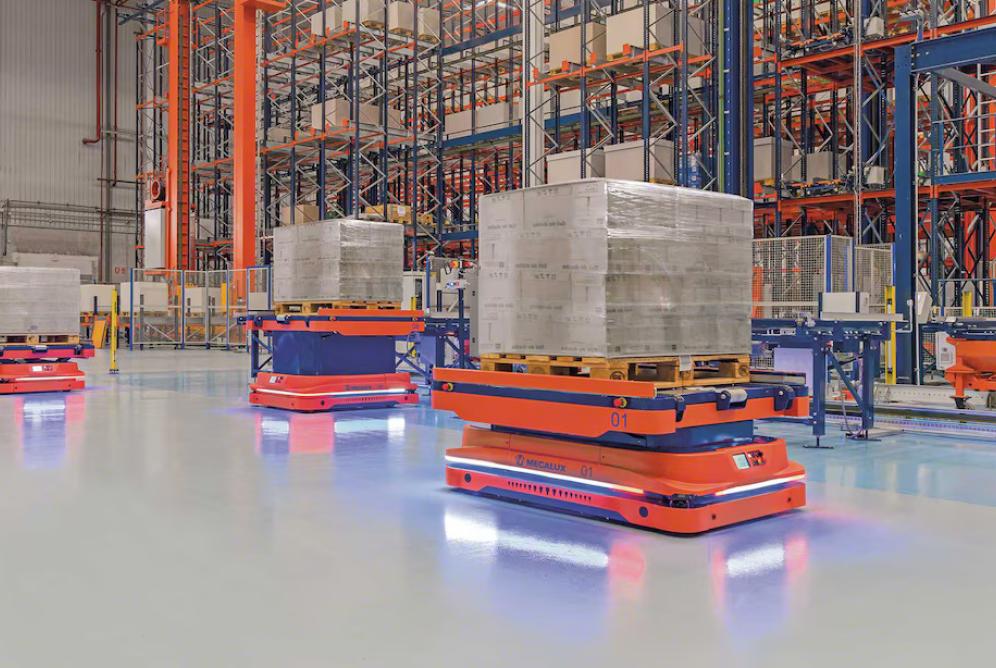
The lab explores the control and impact of advanced logistics systems that independently perform tasks, make decisions, and learn from their environments without continuous human intervention. This includes mobile robots that assist or replace human warehouse and delivery activities, operating autonomously in complex and dynamic settings.
Collective Intelligence
The lab studies the collective behavior and coordination of autonomous systems working together toward a common goal. In intelligent logistics, this means the synchronization and cooperation of multiple agents—such as fleets of autonomous robots—to reach a coordinated, system-level optimum rather than optimizing each agent in isolation.
Spatial Intelligence
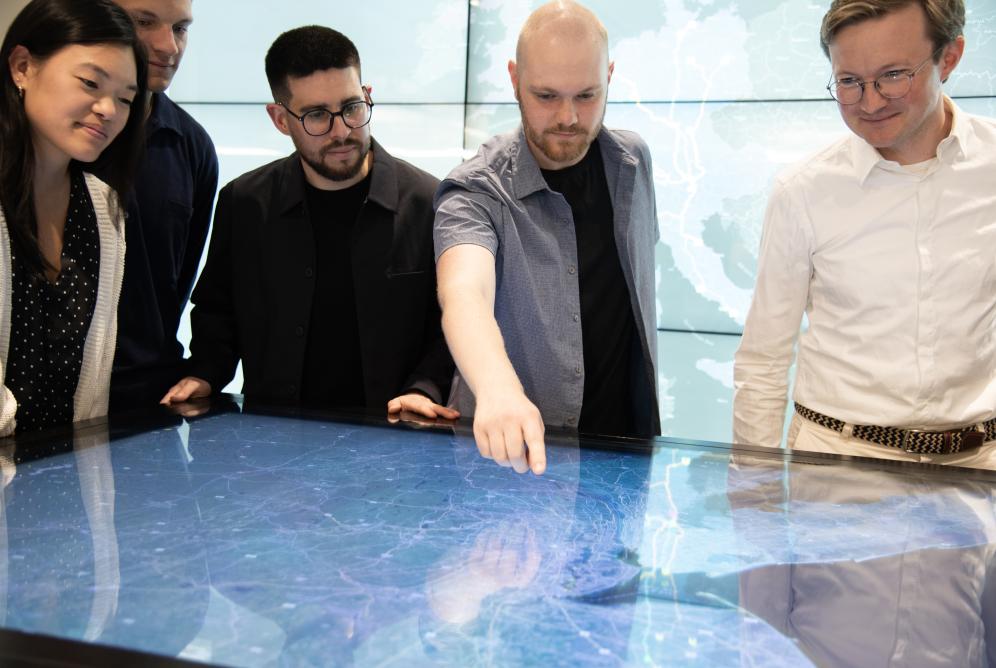
The lab applies multi-modal machine learning and computer vision to the geospatial dimension of logistics, turning heterogeneous public and operational data into actionable spatial insight. Applications include automatically detecting and mapping complex delivery environments to improve last-mile route planning and execution.