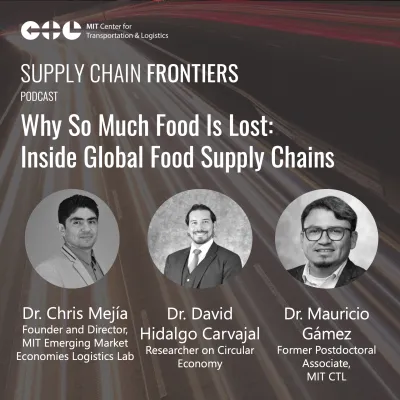
Global food systems produce more than enough to feed the world—yet nearly one-third of all food is lost or wasted. Much of that loss happens far upstream, driven by perishability, cold chain failures, infrastructure gaps, climate pressures, and supply chain inefficiencies that span continents.
In this episode, we’re joined by Dr. Chris Mejía, founder and director of the MIT Emerging Market Economies Logistics Lab, along with Drs. David Hidalgo and Mauricio Gámez, researchers who model solutions for supply chain issues. They unpack why food supply chains are uniquely vulnerable to disruption, especially in emerging markets, and where the biggest opportunities exist to reduce loss. From circular economy models and food recovery strategies to AI-driven forecasting, optimization, and community-based distribution networks, the conversation explores how better logistics, smarter data, and cross-sector collaboration can help redesign food supply chains that are more resilient, sustainable, and equitable.
Transcript
- Hello, everyone. My name is Chris Mejia. I'm one of the research scientists at the MIT Center for Transportation and Logistics. I'm super passionate about improving the situation in emerging market economies, and particularly today, well, about agri-food access models as well.
- And could you speak for people who don't know what are emerging markets?
- So, I would characterize them as low middle income countries that have a lot of potential to improve their current productive and logistics systems, and of course, where economy tends to have many opportunities as well.
- Hello, everyone. My name is Mauricio Gamez. I'm a postdoc at the Center for Transportation and Logistics. I work together with Dr. Chris Mejia, and basically I love doing research in logistics supply chain management, especially for agricultural supply chains. Essentially, what I do is developing quantitative models, either optimization models or simulation models to help companies to better, let's say perform in logistics by reducing food waste and by serving the total demand that they have from the different customers.
- My name is David Hidalgo Carvajal. I also work with models. I try to reinvent it into real life scenarios and I do strategy, but I come more from the sustainability part and do circular economy, which we will be diving into today a little bit more about what it is and why it's important. And I apply this into real world, not only in the US, but also in Europe and Latin America.
- So happy to have you all. Chris, you opened a recent webinar with that staggering stat that I read earlier in the introduction. 11 billion tons of food are produced each year, yet nearly a third of that is lost. Can you set the stage for our listeners, what makes the agri-food supply chain uniquely vulnerable to waste and disruption?
- When we speak about agri-food items, inevitably, we need to link them to perishability, right? So, it's a race against the clock, literally, and this is the reason why you might have plenty of availability of certain food components or issues, ingredients, but at the end they have a shelf lifetime. If I add the component of supply chain to actually transport them between the growers from the point that they were cut from the crop or harvested up to the consumption point, so it's gonna be creating waste. Something that we have realized is that many of the issues that perishability creates is not only the food waste itself, but also food malnutrition, because in general terms, where you tend to find more availability of that food sometimes is not where it's gonna be consumed. Our supply chains have been configured to have or store a little bit more in places where people are wealthier, but the affordability is not necessarily the best. So, what we are trying to do with the models today is to balance a little bit better the system. I also spoke about two specific points, accessibility and perishability, right? The other one that I just spoke briefly about is affordability, right? So, we are very price-sensitive human beings, especially vulnerable population segments are super price-sensitive and we need to make sure to not only bring the fruits or vegetables to them, to their hands, but also make sure that they are able to buy them. The last point that I want to mention here is the awareness component. If the system can fail even if I put an apple in your hand and create food waste, you decide not to eat it. And we have plenty of these examples, and this is behavioral, so that's why this issue is so interdisciplinary and that's the reason why we started working in this extreme of the Emerging Market Economy Logistics Lab that used to be Food and Retail Operations Lab. And this was the evolution, we wanted to not only focus on the food component, but also on other potential commodities.
- And how much of the waste happens at the supply chain level versus after it's delivered to the consumer?
- Oh, this is a great question. Typically, we're speaking about 72% more or less, and only 28% happens on the consumer side. Of course, the numbers change. This is an average and then you need to consider the agri-food waste or the agricultural waste that is due to poor agricultural practices, or in the middle of the supply chain due to many excessive touching points, poor cold chains. The last part typically is the hardest one to go through, to investigate and to solve, because all of us, we want to have more fruits and vegetables in our fridges in case that we have the opportunity to have electricity, power, but let's consider also that around 50% of the population do not necessarily have this opportunity. So, how do all of these people manage this situation? We need to create just in time approaches, right? In order to offer them what they need. But in short, to your question, 72% is lost.
- Happens at the supply chain level.
- Right.
- Wow.
- Yeah.
- So this is where the biggest difference can be made. Passing to you, Mauricio, your work at CTO involves understanding logistics challenges in emerging markets. What are some of the core structural weaknesses that lead to food loss, especially for perishable goods?
- So, when we talk about food loss, particularly for perishable goods like fruits, vegetables, dairy, or fish, this is driven by the structural weakness across the whole supply chain. So, for example, last year, we have the opportunity to conduct an study in an emerging country in Africa called Rwanda. So, we did a study to understand what are the most important needs that this particular agri business had? And some of them highlight, for example, that the lack of certifications and training is one of the most important issues that they have. They don't have, let's say the people are already training to perform the different activities in the supply chain. So, for example, during the handling of the products, what about with the loading and unloading across to the facilities? What about, for example, with the storage to put the produces in different facilities? We need some people already training on that. But they also highlight the lack of financial support. Particularly in Rwanda, they mentioned that most of the agri businesses, they are allocated in different locations of the country, but the financial institutions, they are located in so many specific places and they don't have access to those institutions to get the resources and to invest in what they need. For example, in technology or in people. Also the capacity building, and this is related with the financial issues, the capacity building is I have the right people to perform the activities that I need to do on a daily basis in my agri business. These are the challenges that we can see in emerging economies, but also in developed economies. Also, three years ago I had the opportunity to work in a study in Greece and we understood that these particular argi businesses, they didn't have enough cold chains just to move the goods from one location to another one. And we are quite surprised because we were thinking, "Wow, why we have issue in a country that is considered developed in Europe?" So, we are here to help you to understand better what are the needs and what are the potential actions that we can make in order to solve those issues.
- And can you speak to what a cold chain is?
- The cold chain is how we can keep the freshness of the food along the network. So, imagine during the storage facilities, we need some refrigeration of the goods alone, but also during the transportation in the trucks.
- And David, could you speak to how are issues like environmental impact, which is on a lot of people's minds now and has been for years, how are issues like environmental impact shaping the food security conversation, particularly in emerging markets?
- Something that we all are facing are related to unpredictable challenges regarding weather patterns. It's not only on emerging markets, it's on developed markets, it's everywhere. We are also facing water scarcity, and those are things that have a huge impact, especially in the soil degradation patterns where you can have the stock fed and where food is grown. Agriculture, especially in a lot of emerging markets, can be the backbone of the economy. So, climate change and extreme weather are key barriers because they will have a huge impact in food shortage, and this requires two things. First of all, knowledge in how you deal with this, and second, financial resources, which most of the farmers are gonna be lacking. Third is gonna be reflecting also in supply chain disruptions, especially in environmental degradations related to deforestations, lack of biodiversity, and having something that's called soil erosions, which means that the soil that we are using cannot be reused next year for the same product that we are harvesting. And of course, these would have two consequences. First of all, we will reduce the productivity and also we will increase the transportation impacts. I know all of this sounds absolutely negative, so I want to leave in a positive note that nowadays we have innovative solutions, climate smart technologies, like for example, vertical farming, solar power irrigation systems. But the key question would be, how do we make this affordable? Because now we need to tackle the environmental damage and at the same time, we need to build resistance and resilience.
- And you all spoke a little bit before to the circular economy, so wondering if you could introduce us to circular economy concepts gaining traction in agri-food. What does a circular agri-food supply chain look like in practice and why is a circular model useful for food supply chains as opposed to a linear model?
- When we talk about circular economy, we see from the traditional linear economy, what is the traditional linear economy? It's the take, make, and dispose economy. Basically, we use resources, we extract them, we use, and then after we're done, we just discard them. Now, the idea behind the circular economy is to reintroduce discarded resources back into the system to reuse, recycling, or regenerating at any stage of the supply chain. So, now for agri-food supply chains, sustainable inputs could be, for example, instead of having the traditional synthetic fertilizers, we could be moving into organic fertilizers, promoting farming practices that adopt eco-friendly farming technologies, for example, reducing the amount of organic waste and using this waste that what was going just to be discarded into, for example, creating compose, or generating byproducts, for example, leftovers that can be converted into animal fat, or even being used for generating bioenergy through biogas, through methane, different upcycling, which is basically converting something that is discarded and giving it a new purpose that can be introduced as a new product in another part of the supply chain or as an input for another supply chain. And more importantly is the collaboration across the entire supply chain, because one thing that we are lacking is we consider supply chain as something that one company or one industry needs to do, but it's living outside the collaboration that is key, because we cannot tackle or mitigate climate change by doing it by ourselves.
- Yeah, absolutely. And Mauricio, your work is primarily in modeling. What kinds of models could support the transition to circularity that David was speaking to?
- When we talk about circular economy, especially mathematical models are essential to support decision making, optimize resource flows, and simulate systemic changes. If I go to a specific example, I can mention optimization models. So, for example, if you ask me for a specific definition, I can tell you design a supply chain to minimize total cost and maximize recycled content under capacity and quality constraints. So, we have to consider the constraints that we have in our business, like the capacities, or even budget constraints to decide where to invest or what type of decision we have to make in order to minimize total costs, but also maximize the recycled content. But I can also mention other models, for example, the stochastic models, Monte Carlo simulation. We can use market decision processes just to more or less understand what will be the potential, let's say, disruption that I might see in the future in my circular economy process? So, this kind of models can help us to better predict what is going to happen in the future and we can make better decisions right now just to avoid the final impact that we might have in the future.
- I would like to elaborate a little bit on one of the applications that Mauricio said about modeling because we developed this together when we were working in Columbia, despite the circularity part was not developed when we were working there and when we met. I remember that we developed this project about packaging materials, how to create packages and how to reduce the opening rate. After that, when I started working in the Netherlands, we developed this project to reduce the number of packaging materials that we were using and the number of boxes in the supply chain. And this is just one of the potential applications, because in that sense you start thinking about how much is your returnability ratio or rate, right? And how you can make sure to drive this into practice. And we started looking at how we can increase the level of returnability of those packages directly in the mom and papa stores that exist in Bolivia, for instance. And this is just one of the examples that you can drive into practice and that might be very meaningful for companies. For instance, not many companies have the opportunity to recover their packages because sometimes they consider that is not worth it, but especially with the scarcity and the shortage of many resources, it could be something that we should take into account.
- A wonderful innovation to think about there, and also thinking about how something that was developed in one country can also be applied across the whole supply chain, but continue to think about how we repurpose and rethink traditional models, how can we rethink food loss, not just as waste to avoid, but as a resource that can be repurposed? And wondering if you could speak to some scalable examples of this.
- So, something that we have been developing together with food banks is food recovery. In the supply chains, you can have the food a still edible product and then try to reinsert it or divert it in the corresponding echelons of the supply chain or stakeholders and identify how much shared lifetime that product has. Let's talk about days, and this is also related to freshness. So, we know that as human beings, we are gonna probably consume a banana when it's still yellow, but if you start looking at brown dots, probably you're not gonna get that banana, you're not interested on that. So, how we can identify upstream in the supply chain how that banana should travel the rest of the journey, right? Should we divert that to go directly to the retailer, it's gonna arrive on time so that we can see that it's still yellow or a little bit greenish, yellowish, right? Or should we interrupt, right, that travel and divert it to a community kitchen, to a food bank so that we can do something with that? And that's just recovering the food in the corresponding echelons, including wholesale markets. But this is just one example. The other one that is a little bit more elaborated is proposing the current matter related to that banana so we can actually transform it into something different. Perhaps we can create a powder, we can fry it and create banana chips in order to extend the shelf lifetime time. This is just one of the many potential examples. We do believe that this is scalable, given that you are gonna create like different potential pathways to this particular product, but of course it's costly and we need to start collaborating across the supply chain in order to identify those potential alliances that can make our supply chains more robust, more resilient, and anti-fragile. There's another example that I would like to bring as well here, because at the end you don't want to create food waste, but food is an important resource for life. But in terms of how we can connect better the small holder farmers to the end consumers, there is also the scalable, let's say, models that we are trying in vulnerable population segments, underserved communities. We actually tested something here in Somerville, Massachusetts, also in Brazil, in Rio Grande. Long history short, what we decided to create is to launch a new edition of the corporate supported agriculture that is this small basket with plenty of fruits and vegetables that small holder farmers will create for you and bring it to the doorstep of your house. Naturally, this is very expensive because it's arriving to your doorsteps. So, how we minimize the cost of not even the last mile, the last yard? So we thought we have plenty of what we call nano stores, the mom and papa stores, but the shopkeepers do not have the space or the budget to put these products there. And even worse, they are risk-averse because they don't want to see their products getting spoiled and they are losing money. So, how we could convince the shopkeepers in order to offer these big variety of products and combat also food and nutrition, not only reducing food waste, but also supporting these vulnerable or underserved population segments? We said, "Okay, let's configure a system that is gonna cut all the different intermediaries and it's gonna go between the farmers and the shopkeepers." And then we modeled this, we piloted it, and it has been very successful. Why is this important? There is no one size fits all solution, and we need to consider more direct channels, because many of you would think, "Okay, maybe a farmer's market would be better." Not all the people are actually able to go to those locations. So, how do you actually bring those products nearby these underserved populations that do not have a car, that do not have the opportunity to move around on, or there is no supermarket there? The only point of contact is a mom and papa store. So, we are actually facilitating that and we believe that this is scalable, because at some point, once you configure all the system, you choose the right products, you calibrate and you operationalize the system in such a way that it's deployed continuously and you just keep doing the mechanics, it's gonna work better.
- You bring up a good point, too, in terms of establishing that I believe, you can correct me, a majority of the world relies on mom and pop stores, nano stores as opposed to supermarkets.
- That's right. Just to give you some figures there. So, just in the Sub-Saharan region in India, it's over 90% of the market share. You know, and Latin America is around 50%. In developed countries, it's way lower, it's like around 30%, but we go outside here in Cambridge, Somerville, et cetera, would see many of specialty stores, ethnic-related stores, right? So, they are still important for the population, it's not only in developing countries or emerging market economies, right? We also observe these issues here, food related issues, you know, we have plenty of food deserts, locations that, again, do not offer fruits and vegetables and it's easier to get, let's say, fast food that is not necessarily the best level of nutrition.
- This episode of "Supply Chain Frontiers" is brought to you by the MIT graduate Certificate in Logistics and Supply Chain Management, GCLOG, an elite academic program from the MIT Global Supply Chain and Logistics Excellence Network, geared toward exceptional graduate students and professionals from developing countries who are interested in learning state-of-the-art topics and logistics, freight transportation, and supply chain management and tools to solve real problems from emerging regions. Visit scale.mit.edu for more information. David, you spoke earlier to how climate change is impacting food supply chains, and I wonder if you can speak to how we can make food supply chains more resilient, especially in the face of climate change and other vulnerabilities.
- So, once again, just to make sure that we understand what are the difficulties related to climate change, the first one is absolutely something we feel, it's the unpredictable weather. The second one is the increase on disease risk. And this is something that farmers are wide aware even though we are not. And third one is weather scarcity. Those are the three main things that would have an impact due to climate change.
- And what is weather scarcity?
- Weather scarcity basically is the fact that we have not availability of water access, meaning water is embedded into all the things that we eat and what if we start decreasing the amount of accessible water means that the quality of the products that we eat are lowering, so that is basically the high impact of weather scarcity. Now, how do we build resilience? First of all, we need to diversify production, which means we cannot have one product farming practices. It sounds absolutely weird that ancients knew this, they used to rotate the different crops and we have forgotten about it because we want to maximize production. However, what we're doing is affecting soil. So, that is something that we want to have everything produced now, we want to have it all year long. We want to have berries in winter, which is not the time, but we want them. So, our farmers are doing their best to have this. We are building the supply chains around the world to have rotational crops, but still we are facing these supply chain disruptions because now supply chains are not only in the country where you are, our global networks. So, moving something from one side of the world to another part of the hemisphere means that all the products will face difficulties. So, we as consumers are demanding, that is one big issue, but we need to understand that we cannot afford to have one single product farming practices.
- Which is what the majority of the US farming system is based on.
- Yeah, unfortunately it is. And it's not only the US, it's also parts in Europe and it's also parts in Latin America. The practice is common around the world. So, it's something that we need to work on. Second, we need to adopt climate as more agricultural practices. It's not cheap, but it's worth it that we can have some sustainable practices having, for example, a solar panel irrigation system, which means they don't need to have fossil fuel supply systems to be able to do this. We can take advantage of what is already out there. Then also, we need to invest heavily in data and forecasting tools. Data and forecasting means how do we measure what is going on? And that is going to be very useful not only for Mauricio because of models-
- Sure.
- But for all of us because there's a saying in engineering that whatever you cannot measure, you cannot improve. So, we need to start collecting data, understanding when things are happening, what are the impacts, what is having the connection, such that we can make a smart and well informed decisions. So, we need to take real data collection into account. And finally, we should try to promote local productions. The best thing would be promoting local farming and also seasonal farming, such that we can integrate all of these collaborations, because in the end it's about collaboration. How can I make sure that my neighboring farmer is able to provide the resources that they need? If I support them, otherwise I will be outsourcing that somewhere else. The farmer is not gonna be able to continue improving the quality of the food if we do not support them.
- And Chris, speaking more to resilience in food supply chains, can you speak to the current landscape of local, thinking of something like a farm stand or a farmer's market versus global food supply chains where we're looking at supermarkets with products from around the world, and are there examples where blending short and long supply chains has improved sustainability in food access?
- We live in a globalized world, but now we have all of these movement into local supply chains as well and agri-food components are not an exception. However, I think that it could be good to understand something that my colleagues have emphasized here related to the challenges. Most of the components that we need in order to grow food come from abroad. We speak about the United States, so fertilizers are heavily produced in Morocco, but when we speak about the product itself, bananas unfortunately are not necessarily grown here in the states, so we need most of the tropical products to be imported from elsewhere. So, that's kind of what I call the major league circuit that you need to keep in mind when moving things around the world. If we think about like the traditional food basket for any of the countries, not only American food basket, but also for anyone, you will realize that out of everything that you have there, dairy, meat, potatoes, bananas, whatever you want to add there, tomatoes, for instance, at least I could say 30% of those products are gonna depend on a global supply chain. And it's important to emphasize, because based on that you will need to actually develop different local suppliers, local growers to start guaranteeing that the other 70% on average is gonna be working well as an anti-fragile supply chain. So, what I have seen to be like the most interesting cases around this, we developed a project with our sister center in Luxembourg with one of our colleagues there and we started exploring the food solidarity of Luxembourg and we discovered that in terms of meat, in terms of dairy products, they have plenty. But in terms of fruits, vegetables, grains, they are on a deficit actually. So, how do you correct that? What are the examples that have been successful? Coming back to the corporate-supported agriculture, there is a very successful project in Japan. Japan, as you can imagine, is a country of extreme weather. The summers are super nice, super warm, humid, but the winters are super cold. So, they are able actually to develop a small cooperatives of farmers that are gonna have like a proper combination of products that they need locally, but the model, that's the name of this model, is guaranteeing that the imports that they need from tropical fruits, for instance, are gonna be enough to supplement their food basket diets. And this is very interesting because if you think about it, there is a lot of alliances happening in there, collaboration, and they also need to actually connect the demand to the supply. But to bring this more related to a company, for instance, there is a company that is called Tony Chocolate, and what these guys are doing is developing fair trade, supply chains, and the fair trade here is important, because cocoa is grown particularly in the global south hemisphere emerging markets. But in most of the cases, there is child labor involved. So, what this brand has said is like, "Okay, we want to make sure that we produce our chocolate using local dairy products and some other components that are local," but in terms of cocoa that is their main ingredient, they want to make sure that it's also socially driven, that they are not employing like child labor. But this has gone a step beyond by actually proposing to the families, we are gonna buy your cocoa, but only you allow your kid to go and get an education. So, the reason why I'm bringing this point is because sustainability's important there, and the social component that we typically don't pay attention to is super important as well.
- It's a part of sustainability.
- It is. And sometimes we don't have traceability about that, it's just the context, right? And it's impossible for all the audits to go that deep in the supply chain to double check those points.
- Mauricio, could you speak to any modeling work that you've done toward resilience in food supply chains? Share any examples or outcomes that you've worked with?
- Last year, in the lab we have the opportunity to conduct a research sponsored project with one of our CTL partners. That project we wanted to get to know how we can satisfy the total demand for this particular company, which is producing and selling food to the customers in such a way that we can end that in the final destinations with the highest freshness possible, starting from the moment when those products are harvest, when they go through the whole logistic network, facilities, transportation, and so on, until they arrive to the final destinations, the supermarkets or the stores. So, this project was nice because we develop an optimization problem that is a stochastic. And what is a stochastic? The stochastic component here was that we include elements that might affect the freshness of the food. So, for example, the number of touching points. What are the probability that in facility number one I might have a disruption that might affect the freshness of the food? What is the probability that, for example, in the transportation from location one to location two, I might have an issue with the transportation, for example, lack of people, lack of drivers, or even the cold chain is not working properly? So, this kind of things we simulate and we include in our model in a probability component in such a way that our model is able to capture all of that information and the model is going to provide the best possible decisions regarding the flows of the goods along the network, but also regarding the inventory for how long we should store this production in this facility. And to do that, we develop a bunch of different scenarios with the whole possible disruptions. So, if I remember, so we develop more than 300 of these scenarios, different scenarios. So, the model try to incorporate all of those scenarios and the model replicate the best possible solution for all of them. We didn't provide the best solution for each of those scenarios where we provide the best average solution, including all of those scenarios. But also, as I said at the beginning, we try to maintain the presence of the produce, and in this particular project, we talk about the remaining shelf life of the goods. That was exactly the component that we evaluate. If you want to know the numbers, for example, we were able to reduce the food loss for this particular company in a simulation over a period of three months about 70%.
- Wow.
- In comparison with the current situation of the company. That's a very important number that we were able to reduce.
- From running the scenarios and then adjusting in real time?
- Over a period of three months, running the model on a daily basis. But also, we reduced the inventory, the total inventory cost by 50%. So, this means that the company can make better decisions to better store the products. So, the insight that we told the company was you don't need to buy so much from the farmers, so you need to buy what is exactly needed to satisfy the demand. And we were able to prove that the inventory can reduce by 50% across to the whole facilities. So, this project was fascinated, so we really like, because we use modeling, we use stochastic optimization to tackle a real situation of one of our CTL partners here in the US.
- Pivoting to look at certain emerging technologies that are playing a role in food supply chains, Chris, from your research, do any emerging technologies show promise for reducing waste in perishable supply chains, and how so?
- I think that one of the most interesting emerging technologies at the moment is precision agriculture. That is like this combination of imagery and geographical information systems and using sensors in the ground in order to identify plenty of different information related to the crops themselves. As I mentioned, like around 28% of the losses are happening in the field, in the crops. So, this is something that is very meaningful, and then you can reduce also the consumption of water, reducing the water stress. But given that we mentioned before that also like the percentages increases once you move into the supply chain component, right? You need to have more traceability, and in order to get better traceability, you need Internet of Things, or more sensors, right? You can use also RFID, and based on what we have developed in terms of our own research or the research that we have seen as well, having this kind of history of each agri-food product is important so that you can create actually like the map of its whole life right from the beginning as a seed until the end. And this can give you a very good idea of how much time each of the different elements spends on different stakeholders in transportation, in storage. So, as you can imagine, this can provide a lot of information, and then based on that you can make better decisions about how to divert the products. Something that it could be very important is also to consider the data-driven approaches, right, that Mauricio is mentioning, and we need to be trained on those too, because if we are not aware on how the usage of those models plus the emerging technologies, how we can use them, how these can help us making better decisions, we need to be trained on that. And this is a whole new world and I think that there is plenty of opportunities there connecting emerging technologies with processes, with data, and of course human behavior.
- And Mauricio, can you speak to how predictive analytics or AI play a role in reducing not just spoilage but uncertainty in supply chains?
- Predictive analytics and AI can play a powerful role in reducing spoilage and uncertainty in circular and perishable supply chains. On the one hand, the short shelf life of the products, we need to make sure how long the product is gonna last in the system before the product is bought by the customer. But also, we need to tackle the high uncertainty in the system. We need to get to know what is going to happen with all the touching points that my product is going to have during the supply chain, but also the uncertainty in the demand. This is something that is mandatory for every decision maker in the supply chain. And if we go for particular examples for AI or predictive analysis, so we can talk about demand forecasting. So, demand forecasting is one of the most important elements because the demand is constantly changing. Even now with the new developments of the technology and AI, so where customers can buy online, customers can order their produce in whatever moment, so the demand can change in different periods. So, we need to get to know by using these tools to more or less understand what will be my final demand. If you ask me, so we can use the typical time series and models like ARIMA forecasting methods, but also we can use the machine learning models that are very well known nowadays to better predict the demand. But also, we can also use these particular models to predict the spoilage, so we can use these models to more or less understand, okay, I might have an issue in this facility in the following months and this might affect the freshness of my production. So, these kind models can give us insights about what's going to happen. So, I have to mention this because models usually are wrong, but these models can give us insights, not necessarily the final numbers, but insights in order to get to know what might happen in the future. Based on that information, we can make the decision in our respective companies.
- I see we have a research scientist saying usually models are wrong, but we're getting the insight here, yeah.
- But that is actually why interpretation and experience plays a role there, because if the model is wrong, so who can identify that it's wrong? The subject matter expert, right?
- Right. Which is one of the big issues around the conversation of AI overall in all applications too. So, pivoting more to talk about policy, partnerships, community engagement, Chris, one key theme from your work and you all have mentioned here is the need for cross-disciplinary collaboration from climate scientists to government to logistics experts. What does that look like in practice and any recent examples from your work?
- This is a whole art, right? So, how does this look in practice or why this is important? Let me start with the why. It's important because you diversify and enrich the discussions about a specific topic. Let me put an example. When we started working on diet problems, we said, "Okay, let's put a food basket and let's try to diversify it based on optimization models, right? So, let's try to bring as much nutrients as we can, water content, micronutrients. So, this is actually a very common optimization problem, right? And then when we brought in the nutritionist, she told us like, "No, you are crazy, guys. This cannot happen, right? You cannot work with micronutrients because they change depending if you cook them or your age, depending on many, many things. If you cook them, you freeze them." And then that's when we discovered that these type of constraints that exist in the reality and we might not know because our domain of expertise needs to change. So, this is point number one, it corrects potential assumptions that do not hold in the reality. Second reason why I think that you will be able actually to use better the datasets that you have because you have not only a nutritionist, but an economist or somebody working in geography can take a look to the same dataset and do different things that will carry out like different types of research. So, it's very interesting. And then how we can drive this into practice and make it more scalable. I do believe that if we start welcoming these interdisciplinary teams in your companies, not only in research groups, let me emphasize that, you're gonna be able to enrich your perspective about the same problem. But looking at it from different angles could be important because based on that you can actually look for different strategies, different solutions and work around those in order to maybe create something like completely different, genuine. And I think that this could be actually further scalable because you will be able actually to say like, "Okay, I have this perspective, now I have like consider all of these constraints," and probably the minimal viable product that you're gonna create is gonna be more realistic and you can capitalize on that and make it work. And the last thing that I want to mention here is why is this important? The future is interdisciplinary.
- And what policies local, regional, international, do you think are most urgently needed to support circular and resilient agri-food systems?
- The need to understand multidisciplinary and collaboration and as a witness, something that we can say that has been already implemented through Polytechnic University in Madrid and the cooperation with Madrid City Council, the Center for Innovation in Circular Economy has been created in the city of Madrid. Now, what they have done is creating a space where neighboring communities, meaning regular people, academicians, and industry can go there and have a conversation, which is the first step that we should be taking. And after that they have a start developing solutions, and one of the key thing is called bio-based solutions, which means it's not something that is untangible, but it's considering and taking into account what nature is capable of, because without nature we cannot move forward. So, now regarding the policies, things that are necessary is not only first having a conversation, but also creating subsidies and incentives, because we can be talking about how to solve the world, but the world works on money. So, as long as people is not able to get tax breaks or financial support, unfortunately solutions are not gonna come, or are gonna be absolutely delayed until they have the purchasing power, which most of the farmers don't have. The second thing should be focusing also on waste reduction. How do we deal with that? And it's not only about having a better improved system of waste collection, it's how can we reduce that? And one example that comes to my head right now is one project that we work through one of the educational programs that we have at CTL, the GCLOG, which we implemented in Latin America, especially in Argentina to one of our partners, which is closing the loop for recovering waste oil, cooking oil, and transforming that into biogas, biofuel. So, the idea was there is this company that is doing that already, but they didn't have a good modeling, as Mauricio was mentioning, on how to optimize the collection, first route, second rate, and maximizing the output, cooking oil. If you consider, for example, cooking oil waste that you have at home, you're not gonna be the main customer for them, but restaurants are, and they have a lot of cook oil waste, for example, and they were doing this collection. And thanks to one of the custom projects that we were working, they were able to optimize and reduce the waste that they were being, which is funny because they were wasting waste, unfortunately , but it was reduced, it was optimized, and now they are expanding the footprint in Argentina, they were in one region, now they're almost in the entire country, which speaks volumes of the impact that a capstone project, for example, could have in the educational component. The other thing is absolutely we need to consider infrastructure development. We cannot go on with the current infrastructure, we need to adapt it and we need to understand that, for example, is not only the agriculture infrastructure, it's all the systems that are around. And finally, cooperation. Cooperation should not be only local. That would be the first ideal case, it should be also regional and it should be also international. We cannot go battling against each other if we want to conserve ourselves. And I know this sounds extremely philosophical, but without cooperation we cannot continue to exist, we will cease to exist. So, that would be the corporation, not only economical and financial point of view, but also it's allowing us to avoid having monocycle and only one type of product that is being farmed. So, we are tackling several problems at the same time, I would say.
- Looking ahead to the future of food supply chains of perishable supply chains, what trends in agri-food logistics do you all see emerging in the next, say, five to 10 years that you're most excited or concerned about?
- So, everybody wants to now finally start paying attention to water stress, but I would say not only water stress is important, but also seed management. Without seeds, there is nothing. Without water, there is nothing we can grow, right? So, this is from the very beginning and this requires a lot of understanding of supply chains and how the process will start.
- And I just want to add on what Chris mentioned, technology is moving forward very fast. So, a couple of examples that I have been seeing in , one of them specifically in Spain, is company that is using drones to check for harvest control quality, but it is not only about pesticides and having imagery of the crops. They are using imagery to train through machine learning and see the quality of the crops, if they are having any pest, if they're having any disease. So they are trying to predict that before that is happening. And in countries where, again, agriculture is the backbone, these kind of technology would be key, would help the different farmers to reduce the impact of food waste. So, having technology, technology is great, but using the right hands, or using the right way, that would be the invitation here, 'cause the key thing here is technology is going to be there, but accessibility, prices, food is one of the key things that we need to be alive and if we are not able to provide the technology accessibility to the people who is bringing the food, then we're gonna be in big trouble.
- And if you all could leave listeners with one practical action, whether they're policy makers, industry professionals, or just conscious consumers, what would it be?
- So, lemme start from the point of view of mathematical modeling, I will say start collecting and sharing the right data and the right resolution to enable effective modeling and decision making. So, there is no model that can provide probably a good solution if we didn't feed this model with the right data, with granular data, or with accurate data. If I ask you to check in detail what you have done, and that is where and when the food is lost, check is in the harvest, is in the trends, in the transportation, is in the storage, or is in the retail, check the quantities in bulk on that, so check how much you are shipping from one location to another one. Check how much you are losing in terms of food from one location to another one. Check the the degradation of the shelf life of the products, change the constraints of your network capacities, financial constraints, check everything that you have on hands to get to know how much you can produce, how much you can sell, how much you can serve. So, these kind of things can help decision makers, even policy makers or industry people, just to make better decisions when we have to handle food or when we talk about circular economy,
- I would say to any listener who is already a conscious consumer because you're listening to us, thank you for listening, but second, just think about this. Whenever you go to a supermarket, imagine that you're purchasing whatever amount, then you put it in four bags, and on the way back home you just drop one. You already paid for it, but you arrive home with three out of the four. That is statistically the 25% of waste that we generate as customers, as consumers. Whatever we bring home, we sometimes for some reason don't consume all of it and we are generating waste. So, the first step should be, and speaking by experience, I'm nagging myself into this at the same time, is make sure that whatever you're purchasing, you're gonna use it. If a banana gets a little bit brownish, it's still edible. The nutritious part of the product is there. Second is we love perfect fruits. When we go to supermarket, we are in love with very rounded and apple-shaped apples. If we see some weirdly-shaped apple, it's the same fruit, it's the same product, so we shouldn't be just considering a good, perfectly beautiful product as the one is gonna be bringing me the high nutritious value. All of the products, unless they're like absolutely spoiled, have still the same nutritious value for all of us. So, that would be my two cents. And support your local communities.
- Right, on my side, I was about to say that support your local producers and retailers because they are there to make your community safer, and I could say also healthier. Secondly, I could say you need to probably adjust a little bit your shopping habits, and I put myself here also. So, when I go to the supermarkets, I see plenty of bananas, you know, and typically you see the complete bunches on one side and the loose ones on the other side. There to take the loose ones, they taste the same, I promise you. So, the last one is a little bit more professional. Embrace the differences in your teams. You know, I think that that's particularly important. And most cumbersome, try to like capitalize on them to make better decisions. And as mentioned by Mauricio, like also empowering your own teams to use data-driven approaches to support your daily decision making and your professional decisions too.
- That wraps up this episode of "Supply Chain Frontiers." A big thank you to Chris Mejia, David Hidalgo, Mauricio Gamez for sharing their expertise and insights into the current state of food supply chains and how they impact our everyday lives. To learn more, please visit scale.mit.edu. "Supply Chain Frontiers" is recorded on the MIT campus in Cambridge, Massachusetts. Our sound editors are David Lishansky and Daniel Simpson at David Benjamin Sound, and our audio engineer today is Kurt Schneider of MIT Audio Visual Services. Our producer's myself, Mackenzie Berry. Be sure to check out previous episodes of "Supply Chain Frontiers" at ctl.mit.edu/podcast, or search for us on your preferred podcast platform. If you enjoyed this episode, please subscribe. I'm Mackenzie Berry. Thanks for listening and we'll catch you next time on "Supply Chain Frontiers."


