April 29, 2026 Webinar Recap
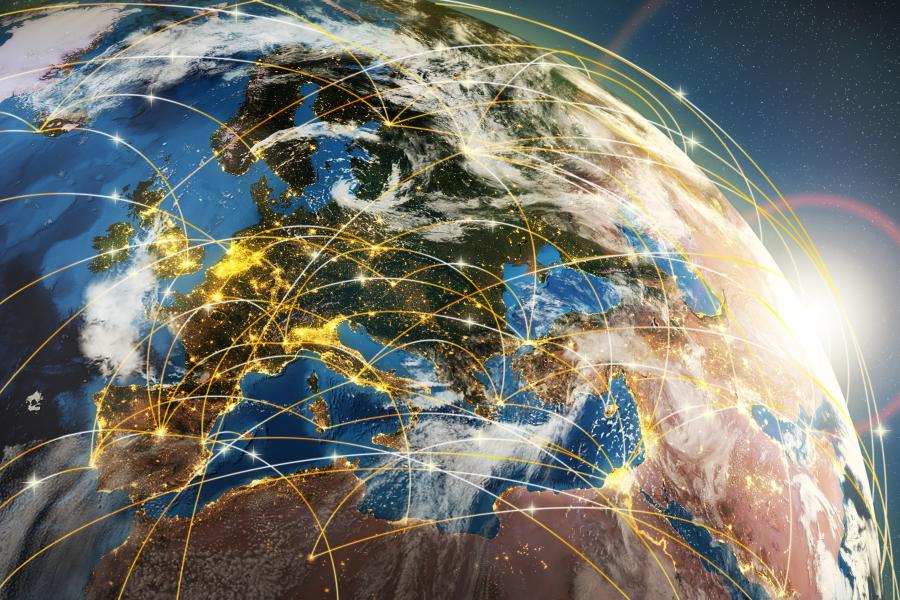
On April 29, 2026, the MIT Global SCALE Network convened leading supply chain experts to address a critical question: Are we witnessing temporary turbulence, or a permanent rewiring of global supply chains?
The webinar brought together four accomplished researchers from across our SCALE centers to explore how geopolitical tensions and trade fragmentation are reshaping supply chain strategy.
The End of Stable Assumptions
Dr. Christopher Mejia Argueta from the MIT Center for Transportation and Logistics (CTL) opened with a stark observation: supply chains have become "front lines" where geopolitics, resilience, and security intersect.
Dr. Gerardo Heckmann from the Center for Latin American Logistics Innovation (CLI) agreed, noting that "Geopolitics has become a first-order constraint for our supply chains. We are witnessing the end of an era in which firms can assume that markets, trade rules, and logistics corridors were broadly stable."
Three concurrent trends underscore this change: trade fragmentation driven by U.S.-China tensions, the elevation of energy and critical minerals from commodities to strategic assets, and the weaponization of financial tools to shape where firms source and manufacture.
Beyond Silos: A Systemic Approach to Resilience
Dr. Yasmine Sabri from the UK SCALE Center at Loughborough University challenged traditional, siloed approaches to resilience. Essential supply chains such as energy, food, and healthcare share digital networks and financial systems. "When there is one disruption in one system, it actually cascades down to all other systems," Sabri noted.
She called for moving from "capability-focused" resilience toward "systemic, design-led focus," redesigning supply chains themselves to withstand interconnected shocks.
Keeping Options Open: Practical Wisdom
Prof. Joachim Arts from the Luxembourg Centre for Logistics offered three compelling analogies. First, "Nobody gets credit for solving a problem that never happened," implying that conflict prevention cannot receive the credit it may deserve. Nonetheless, unprepared companies don't survive adverse events.
Second, he invoked "survivor bias": just as military planes hit in certain locations never return, companies lacking resilience simply disappear during crises.
Third, he drew from chess strategy: "Rather than getting to some very targeted goal, the point is to make sure you have many options at any given time." For supply chains, this means maintaining geographically dispersed sourcing even when one option is economically superior. "This is a temptation that we should learn to resist."
The Real Cost of Resilience
Dr. Rafael de Miguel Gonzalez from the Zaragoza Logistics Center highlighted concrete examples: companies such as Inditex must relocate air cargo contracts when shipping corridors close. "You have to confront geopolitical disruptions in organizational and financial terms in mid and long term," he stressed.
In turn, Dr. Heckmann reframed resilience investment as value creation. Shifting from "just-in-time" to "just-in-case" models, built on strong supplier relationships, can reduce delays and uncertainty. "Perhaps our customers will want to pay much more if our service includes this relationship," he noted.
Critical Assumptions That No Longer Hold
The panelists identified foundational assumptions that are now invalid:
- Economic dependence prevents conflict. As we've seen, trade interdependence won't prevent geopolitical conflict.
- Markets override politics. In fact, political objectives can override market efficiency for long periods of time.
- Tariffs won't disrupt supply chains. Countering this assumption, China's exports grew 40% in Q1 2026 despite U.S. tariffs.
- Long-distance trade partnerships remain viable. Due to geopolitical instability, regions are reconsidering regional versus distant supply chains.
- Sustainability timelines are fixed. Instead, geopolitical disruptions are altering decarbonization commitments.
The Path Forward
The researchers noted several themes consistently:
- Strategy matters as much as resilience and integrating geopolitical awareness into supply chain design is imperative.
- Build bridges rather than settle for siloes. To cope with continuous disruptions, cross-organizational alignment built on trust is essential.
- In response to global fracturing, regionalization is likely, but it varies. Expect regional fragmentation tailored to geopolitical exposure.
- Resilience requires cultural change—even during stable periods, resist disinvesting from it.
About the MIT Global SCALE Network: The MIT Global SCALE Network is an international alliance of leading research and education centers dedicated to advancing supply chain and logistics excellence through innovation, collaboration, and real-world impact. Spanning four centers across four continents, SCALE brings together students, researchers, and faculty to educate future supply chain leaders, conduct applied research and work closely with industry partners to solve complex global challenges.


