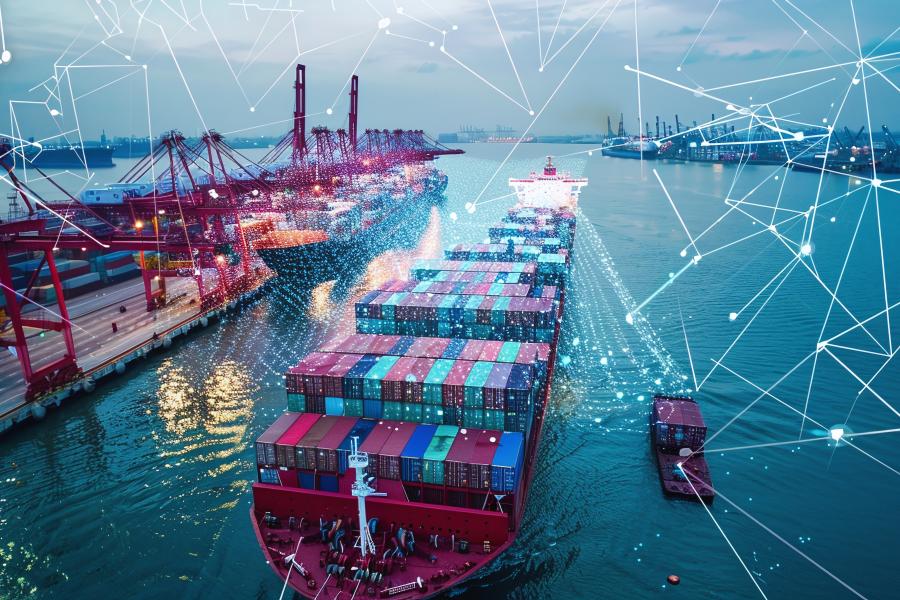
In a short span of time, artificial intelligence has moved from experimentation to operational necessity. In supply chains, where delays, disruptions, and forecasting errors can cascade globally within hours, organizations are increasingly turning to AI to improve decision-making speed and resilience. The challenge facing companies is organizational as well as technological, as many firms now face a widening gap between the sophistication of AI tools and the readiness of the workforce expected to use them.
According to the World Economic Forum, nearly 40% of core job skills are expected to change by 2030, with AI and big data among the fastest-growing capabilities across industries. The report also found that 77% of employers plan to prioritize workforce upskilling in response to AI-driven transformation.
Compared to other sectors, supply chain management may feel these pressures more acutely because modern supply chains already generate enormous volumes of operational data: inventory levels, vessel movements, customs documents, supplier communications, warehouse footage, customer demand signals, and pricing fluctuations. Historically, organizations have relied on fragmented systems and human judgment to interpret this information. However, the scale and speed of today’s disruptions increasingly exceed what conventional planning methods can effectively manage.
Now, AI is beginning to fill that gap across several applications. For one example, machine learning systems can identify demand patterns across thousands of products simultaneously, resulting in breakthroughs such as GENESIS, an AI simulator tool that optimizes warehouse inventory. In another, computer vision tools can automate warehouse and manufacturing inspections, increasing efficiency. Furthermore, natural language processing models can classify trade documents and process supplier communications, freeing up substantial time to direct to higher level work. Attuned to rapidly changing conditions, reinforcement learning systems can optimize pricing and inventory decisions dynamically as these conditions change in real time. Large language models are also introducing new possibilities for operational decision support, enabling teams to interact with complex systems conversationally rather than through specialized coding environments.
Research from MIT CTL has documented how these capabilities are rapidly expanding across supply chain operations. One recent study argues that generative AI is poised to influence decision-making across at least 13 major supply chain and operations management domains, including forecasting, logistics, procurement, inventory management, and risk assessment. Another MIT CTL study demonstrated how AI and machine learning forecasting models can improve cold-chain capacity planning, helping organizations respond more effectively to shortages and uncertainty.
At the same time, researchers increasingly warn that technology alone is insufficient. A recent study on AI-driven supply chain transformation notes that competitive advantage depends heavily on whether organizations can combine technical systems with human judgment, transparency, and operational understanding. With the shifting landscape, supply chain professionals are now expected to evaluate AI tools, interpret model outputs, understand data limitations, and collaborate effectively with technical teams, often without formal backgrounds in computer science.
This transformation bears significant implications for operational leadership. To meet the demands of the AI era, the goal must not be to turn every supply chain professional into a software engineer, but to create organizations where managers can work fluently alongside AI systems, ask informed questions about implementation risks and opportunities, and identify where these technologies create measurable operational value. As autonomous and semi-autonomous systems become more common, AI literacy will increasingly become less of a specialty skill and more of a baseline business competency.
In response, universities, research centers, and companies are expanding applied AI education for operational professionals. Particular to supply chain professionals, CTL is offering The AI-Driven Supply Chain, a 5-day training which focuses on practical implementation rather than abstract theory, emphasizing forecasting, optimization, generative AI, computer vision, and autonomous agents within real supply chain environments. As AI adoption is no longer confined to research labs or software firms and is becoming embedded into the operational fabric of global commerce itself, the organizations that adapt fastest and invest in upskilling their workforces may define the next era of supply chain competitiveness.


