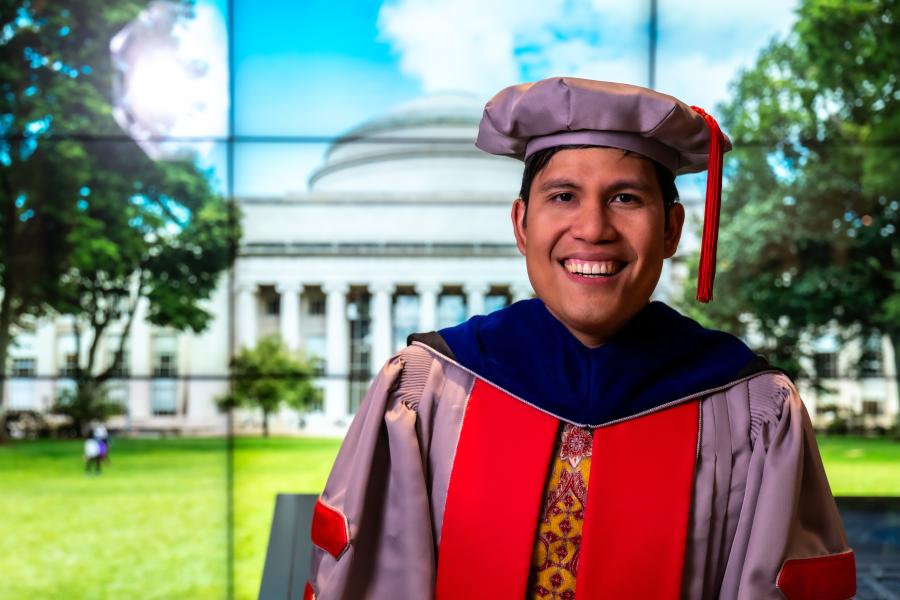
You could say that Austin Saragih's path to a PhD from MIT began not in a lecture hall, but with an online video. Working full-time as a last-mile logistics project manager at Shopee, a Southeast Asian e-commerce company, in Jakarta, Indonesia, Saragih discovered the MITx MicroMasters® Program in Supply Chain Management in December 2018. A colleague mentioned one of the courses, and despite the cost on his Indonesian salary, Saragih decided to give it a try.
Then he watched the first lecture from the Supply Chain Fundamentals course. "The first video on it was Chris Caplice," Saragih recalls. "He was showing me the supply chain as a whole. And from that moment, I thought, yes, I will definitely finish this program."
Eight years later, Saragih has become the first student to complete the entire end-to-end MIT CTL educational pathway: from MicroMasters learner to Supply Chain Management Blended Master's student to PhD graduate. His journey, undertaken while working full-time and later joining the master's program, was ultimately rooted in Saragih’s love for teaching and sharing knowledge.
The Rigor of Remote Learning
Saragih approached the MicroMasters program with the same intensity he would later bring to his doctoral research. Balancing coursework with a full-time job meant studying in the evenings after work, pacing through videos, and solving problem sets against course deadlines. The material was challenging, and deliberately so.
"For us, this was really challenging content. You genuinely have to study hard. It's very rigorous," he recounts. This rigor was precisely what drew him in. The course struck a balance between mathematical depth and intuitive understanding.
"I feel very proud about the MicroMasters because it was so rigorous. I felt proud of scoring well and finishing it." His dedication paid off. He maintained a 90 percent average across the courses, well above the 85 percent threshold he learned would qualify him for the blended master’s program.
A Pathway Emerges
Approximately one year into the MicroMasters program, Saragih learned about the blended program through a live MicroMasters event. Eva Ponce, the program director, mentioned that students with strong scores could apply to pursue a Master's in Supply Chain Management just five months on the MIT campus rather than a full year. Simultaneously, Saragih became a course teaching assistant for the MicroMasters program, connecting him with a community of learners around the world.
"What I really appreciate about that time is that there were a lot of live events," Saragih says. "When I made comments, the course lead would say, 'Yes, Austin asked…' and I felt like I was an actual MIT student, even though I was not yet!"
Given his strong scores, he was accepted to the blended program. There, he worked on a capstone project with Dr. Chris Mejía, which entailed working on a team of students to help a company solve a real-world supply chain issue. In that work, something shifted for Saragih. Without the pressure from his day job to finish quickly and move on, Saragih found himself craving deeper understanding of the complex issues at play.
"When I was solving problems without the industry constraints," he explains, "I could actually understand and learn deeply. I thought, I think I want to do a PhD."
Betting on Passion Over Financial Reward
From the moment Saragih applied to the blended master’s program, he knew he wanted to become a professor of supply chain management. Excitedly, he replayed a video from his MIT SCM application, in which he shared that his dream is to become a professor, and that he wanted to complete the program as a stepping stone to that goal.
However, he was aware of the financial stakes of this passion. "[After graduating], I could have worked at McKinsey or a large consulting company," he reflects. "I could have worked at Wayfair, I could have worked at Amazon. The salary of those jobs were higher than the salary of the professor position that I could have five years later. I could have tripled my salary in that time."
Saragih was driven by a conviction deeper than career prospects. His decision rested in a deep knowing that understanding something profoundly and then sharing that knowledge with others was how he wanted to spend his life. "I love learning and understanding and I love sharing knowledge," he says. "And when I understand something deeply and then am able to share with others, it just makes me feel like this is what I want to do for life."
Research on Resilience
Saragih's doctoral research, funded by pharmaceutical company Roche and the MIT Climate and Sustainability Consortium, focuses on how companies can design supply chain networks in the face of uncertainty.
He has co-authored multiple papers with faculty advisors Milena Janjevic, Yossi Sheffi, Jarrod Goentzel, and Matthias Winkenbach, all of which share research that bridges academic rigor with practical application. Throughout his doctorate, he has also taught as a recitation instructor in four MIT SCM courses and an undergraduate optimization class at MIT Sloan.
Reflecting on his teaching, he shares, "I've been in their shoes. I know how to parse what matters from the math and what matters in practice and marry them together."
Opening Doors for Others
Perhaps most significantly, although Saragih is the first MicroMasters learner ever to complete his PhD at the MIT Center for Transportation and Logistics, he will not be the last. His success has illuminated a pathway that others are taking. There are now several current PhD students who started their educational pathways in the MicroMasters program.
"The MIT CTL ecosystem gives an end-to-end educational path," Saragih reflects with evident pride. "From MicroMasters, as an outsider and as people who are working and who want to improve their skills, all the way to finally getting a PhD from MIT."
Now that Saragih has completed his PhD, he is preparing to start his new role in September 2026 as Assistant Professor of Business Analytics and Operations Management at Kühne Logistics University in Hamburg, Germany.
In finishing this chapter, Saragih's message to potential MIT students worldwide is clear: your starting point doesn't determine your endpoint. "Uncertainty is the new certainty," he says—a mantra that applies equally to supply chains as to life. "But we can prepare for it thoughtfully, strategically, and together."


