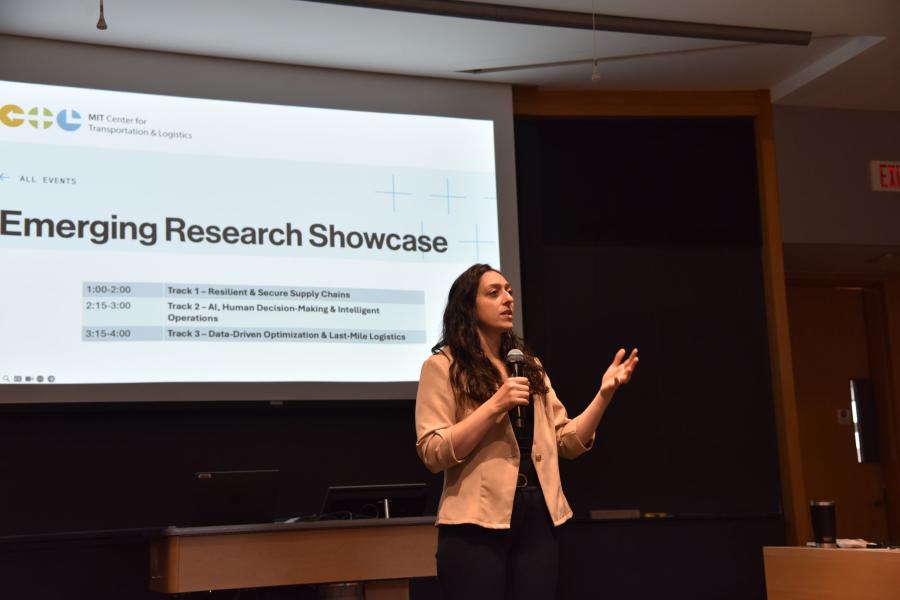
The MIT Center for Transportation and Logistics (CTL) held its second annual Emerging Research Showcase on May 14, 2026, bringing together junior researchers, postdocs, and industry partners to explore innovations in supply chain management, artificial intelligence, and logistics optimization. The event featured nine emerging researchers presenting work across three interconnected tracks: resilient and secure supply chains, AI and human decision-making, and data-driven optimization for last-mile logistics.
Track 1: Building Resilience in an Uncertain World
The morning session opened with a sobering reminder of modern supply chain vulnerabilities. Miguel Rodriguez Garcia presented on supply chain cybersecurity, highlighting the $6 trillion annual cost of cybercrime in 2025—equivalent to the GDP of the world's third-largest economy. Drawing on real-world cases like the mid-2025 UNFI cyberattack that left supermarket shelves empty and the Jaguar Land Rover disruption that cost the company $2.5 billion, Garcia emphasized that prevention alone is insufficient. Instead, he seeks to build a consortium model focused on mitigation and recovery strategies, helping companies develop playbooks for resilience when attacks inevitably occur.
Ilya Jackson took the focus upstream, examining how vulnerabilities propagate through global supply networks. Through a combination of web scraping, generative AI, and proprietary data sources, Jackson has mapped the deep-tier supply chains of major corporations, capturing data on 80,000 companies and approximately 250,000 buyer-supplier relationships across 93 countries. By stress-testing scenarios like the 2011 Germantown Marl fire which unexpectedly halted the German automotive industry, Jackson demonstrated how small, obscure suppliers can represent critical vulnerabilities. The research revealed that when disruptions occur, companies attempt to source from alternative suppliers, and whether recovery succeeds depends on geography, prior relationships, and available capacity. Jackson is seeking industry partnerships that can provide proprietary bill-of-materials data to refine his model further.
The human element of supply chain resilience took center stage with Angi Acocella's presentation on freight transportation challenges. With a staggering 90% attrition rate among truck drivers and drivers averaging only 6.5 hours of actual driving time despite being allowed 11 hours per day, the industry faces a $5 billion annual cost associated with driver shortages. Acocella is tackling this through three complementary projects: identifying where drivers lose productive driving time, developing a parking prediction app to help drivers locate rest areas more efficiently, and building models that incorporate driver preferences into routing and assignment decisions.
Katya Boukin extended the resilience theme to infrastructure, focusing on post-flood logistics. With flooding events now occurring with increasing frequency and severity across the United States, from North Carolina to Alaska in recent months, Boukin emphasized that most states lack data-driven policies for post-flood road access. Her framework combines flood hazard modeling, road vulnerability assessment, and Monte Carlo simulations to identify critical infrastructure and optimize rerouting before disasters strike. The research promises real-time, resilient routing corridors that balance logistic capacity with long-term infrastructure recovery planning.
Track 2: Humans and Algorithms Learning to Work Together
The afternoon's second track explored how artificial intelligence can augment rather than replace human decision-making in supply chains. Thorsten Greil presented behavioral research on conversational interfaces powered by Large Language Models (LLMs). In controlled laboratory settings, participants using a natural language chatbot to support supply chain design decisions showed 17% improvement in selecting objectively better solutions and 35% closer alignment with their stated risk-reward preferences. Interestingly, Greil also identified an unexpected bias: participants tended to "overshoot" their risk tolerance, likely influenced by the system's tendency to affirm suggestions. Future research will explore how humans and algorithms perform when they possess asymmetric information, which is a more realistic scenario where both parties must navigate incomplete knowledge.
Thomas Koch, referncing work initially developed through an MIT SCM capstone project with a large pharmaceutical company, presented on procurement data accessibility. In many organizations, hundreds of dashboards accumulate over time, each designed for specific queries, but few are actively used or maintained. Koch's solution is a self-service chatbot that allows non-technical procurement staff to query data in plain English. The system generates SQL queries, visualizes results, and presents the underlying code for transparency. It does so without vendor lock-in, as the solution runs on local hardware using open-source models and libraries. Early testing showed the approach could dramatically reduce time-to-insight compared to traditional BI department workflows, though Koch emphasized the need for production pilots with real data and governance frameworks to ensure responsible deployment.
Willem Guter introduced warehouse foundation models, applying transformer-based AI architectures (the technology underlying LLMs) to warehouse operations. Rather than teaching machines to speak language, Guter is teaching them to "speak warehouse," learning the complex interdependencies between pallet flows, labor, suppliers, customers, and external factors. Once trained, these models can serve as fast, end-to-end simulators running in seconds rather than hours, and provide AI-ready "warehouse embeddings" that allow different autonomous systems within a facility to share context. While Amazon has published research on similar approaches, Guter noted the company is not sharing models publicly, suggesting they may have identified significant competitive advantages. Guter is seeking partnerships with companies operating automated warehouses to validate and refine the approach.
Track 3: Optimization Meets Operations
The final session explored machine learning approaches to real-time logistics decisions. Sarah Schaumann presented a hybrid machine learning and operations research (ML-OR) framework for decisions ranging from truck routing to online order fulfillment. In one project, models trained on historical routing data achieved speed improvements over traditional solvers while maintaining solution quality, with performance gains accelerating when solving problems within familiar geographic areas. In a second project conducted with a major e-commerce company, Schaumann’s work outperformed the company's longstanding rule-based fulfillment logic by training models to predict which warehouses would best serve future demand. Schaumann outlined three criteria for identifying good ML-OR candidates: decisions that are either too slow or outdated, repetitive decisions with available historical data, and decisions with measurable business impact.
Camilo Mora concluded the showcase with a focus on informal last-mile logistics in developing markets. With e-commerce growing at 14% annually and reaching a $5 trillion market, the assumption that delivery looks the same everywhere and that automation is inevitable breaks down in cities like Monterrey, Mexico. There, drivers manually enter 200 addresses into Google Maps one by one, create routes in their heads based on local knowledge, and sometimes organize packages on sidewalks to optimize delivery sequences. Mora's team, which has been collecting data on last-mile distribution to mom-and-pop shops, or nanostores, since 2022, emphasizes that these informal networks serve 4 billion people globally and represent the primary income source for millions of delivery workers. Understanding and optimizing these systems requires different tools and perspectives than those applied to Amazon or UPS operations.
Looking Forward
The showcase reflected CTL's commitment to research on urgent, real-world supply chain challenges. As Matthias Winkenbach, the CTL’s Director of Research, noted in his opening remarks, the goal is to give emerging researchers exposure to practitioners and feedback that will help them refine their research portfolios and to introduce partners to cutting-edge research from emerging talent. For companies seeking research collaborations or validation partnerships, the showcase suggested fertile ground for innovation at the intersection of academic rigor and practical impact.


