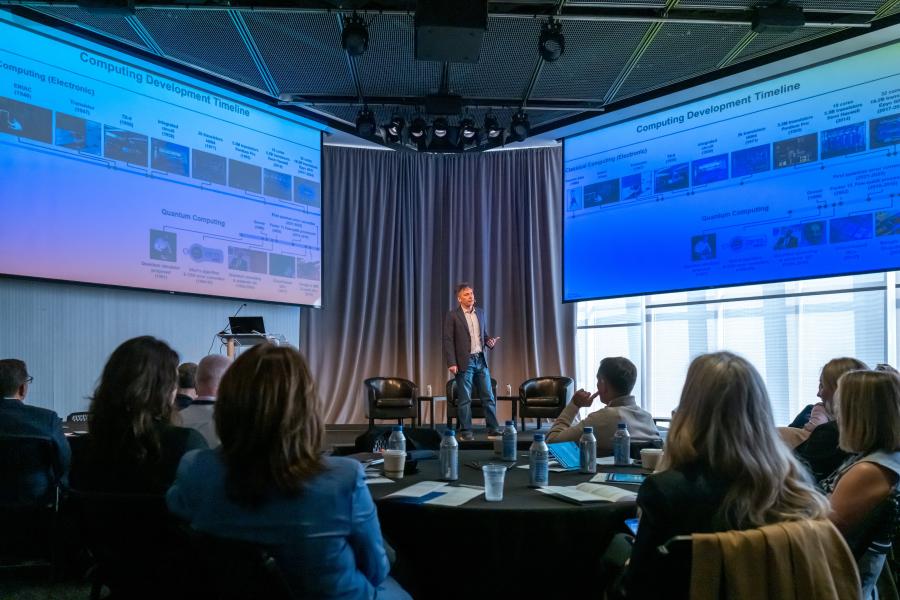
The 2026 annual MIT CTL Crossroads Conference brought together supply chain leaders to explore a number of intersecting forces reshaping global logistics: quantum computing, energy infrastructure, geopolitical trade dynamics, demographic shifts, AI adoption in the workplace, and the next generation in logistics. Held on MIT's campus, the day-long conference served as both a health check for the industry and a roadmap for executives navigating unprecedented operational challenges.
Quantum Computing: Its Potential and Current State
Professor William Oliver opened the morning with a measured assessment of how companies should approach quantum computing. “Don’t bet the farm on quantum right now,” he advised, “but, do start building small teams to identify your biggest problems and probe how quantum may be able to solve them.” Without dedicating some focus on quantum computing now, companies may find themselves left behind in the years to come by competitors who are focusing on the new technology.
In terms of timeline, Dr. Oliver, a Professor of Electrical Engineering and Computer Science, cautioned that commercial applications for quantum computing are likely 5-10 years away. However, its potential impact is significant.
Dr. Oliver offered the example of the pharmaceutical industry. Consider a company that currently invests $10 billion over a decade to bring drugs to a human trial, only to find out the drug is not viable. Quantum computing could rapidly run simulations to more accurately determine the viability of a drug before investing in it, offering much more accurate information before deciding on investments. The technology also has major implications for cybersecurity, as Dr. Oliver acknowledged that post-quantum encryption upgrades are already urgent security priorities.
Rather than replacing classical computers, quantum computers would need to run alongside them. This has important implications for an energy infrastructure already strained by increased demand from AI data centers and electric vehicles (EVs).
Energy Infrastructure: The Silent Tier 1 Supplier
The subsequent presentation addressed current energy concerns by offering a pulse check for where our energy infrastructure stands and what it stands to face. Brent Brunell, Technology Director of GE Vernova Advanced Research, exposed what some supply chain operations take for granted: “the grid is your silent Tier 1 supplier,” and its energy demands are ballooning.
To meet the expected increase in demand, we would need to build as much electricity capabilities in the next 25 years as humanity has built in the last 150 years. Driving the energy demand are new data centers to power AI and increased use of EVs, both for personal use and freight. The supply chain impact risks include power quality degradation, rising outage risks, and energy cost volatility.
As GE Vernova generates 25% of the world’s electricity, they are working on several solutions. These include small modular nuclear reactors, carbon capture (they currently remove 1500 tons of carbon from the air per year), hydrogen fuel, and direct air capture, but there are constraints, such as governmental regulations on small nuclear reactors.
For supply chain leaders, energy resilience must be top of mind the in years ahead and considered a supplier that requires close monitoring.
Strategic Trade in Times of Conflict
MIT political scientist Mariya Grinberg reframed how conflict between nations shapes trade. Conventional wisdom holds that "trade is the first casualty of war," but the evidence is more nuanced. Drawing from her forthcoming book, Trade in War: Economic Cooperation Across Enemy Lines, Grinberg relayed that states evaluate trade on a product-by-product basis according to a tradeoff between military incentives and economic incentives. The critical calculation is conversion time—how long raw materials take to become finished military goods. If that timeline exceeds the war's expected duration, trade continues.
This framework proved prescient when panelists discussed current supply chain workarounds. These have included suppliers finding ways to source from China indirectly through Vietnam, creative export substitutions, and renting AI semiconductor chips rather than purchasing them, for example. One of the panelists, Liza Lin of the Wall Street Journal, concluded that “if there is demand, there will be supply,” one way or another.
For companies, an important takeaway is that historically, nations care if an industry survives a time of war or conflict, rather than if individual companies survive. However, companies have been successful in requesting revisions to any product bans if they can prove the adjustment will not benefit an adversary.
Navigating AI’s Impact on the Workforce
Currently, the discussion of AI’s impact on the workforce remains shrouded in generalizations and uncertainty. Professor Yossi Sheffi and Ph.D. student Pierre Bouquet of the MIT Work Analytics Lab presented a paradox that complicates automation strategies: while AI can handle individual tasks, jobs aren't modular. Unlike blue-collar factory automation, which cleanly eliminated repetitive tasks, white-collar work involves tasks woven together in ways that resist simple substitution.
To specify AI’s impact on particular companies, Bouquet introduced attendees to a tool he created which uses a company’s data to offer specific insights into the company’s tasks that are automatable by AI and the money and/or time that would be saved by automating tasks for each role. By automating some of their more expensive tasks, time can be freed up for employees to focus on more high-level work.
Having traced the world’s previous industrial revolutions, Professor Sheffi advised that while some jobs may become obsolete as with previous technological innovations, new jobs are also emerging, and many sectors of the supply industry are facing labor shortages.
Demographic Change: The Structural Shock Hiding in Plain Sight
Dr. Joe Coughlin, founder of the MIT AgeLab, presented on how changing demographics will dramatically impact the workforce and the services and products people will need: worldwide birthrates are declining and people are living longer than ever before.
Dr. Coughlin offered a surprising data point: if the current pace of progress in life expectancy continues, half of people born in the 1990s and 2000s will live to be 100 years old. This is both a healthcare challenge and a structural shock reshaping labor markets, consumer behavior, and risk.
There are several key demographics reshaping the supply chain:
- Over the past 70 years, global birthrates fell by 50%
- By 2047, the population of retirement age will exceed the number of babies born that year
- 60+ populations control 30% of global spending
- 52% of 18-to-21-year-olds in the U.S. live with their parents
While Africa remains a population growth exception, as the contient is exceeding the rate of population replacement, every other continent faces an unprecedented labor shortage precisely as the workforce must support aging populations. The pattern is: as income and education rise, so does longevity, meaning wealthier regions face the most acute demographic pressure.
Dr. Coughlin urged both the public and private sectors to stop “kicking the proverbial can down the road,” as once the most dramatic demographic changes are realized, we will be far behind in adapting to them.
The Crossroads, Clearly Marked
The day concluded with a panel on the next generation in logistics and what supply chain leaders look for when building their teams. The panelists highlighted that the top traits they look for when hiring include intellectual curiosity, problem-solving, and a willingness to take responsibility for their work. They also highlighted the importance of leadership creating an environment in which they invite constructive criticism and debate.
Ultimately, the 2026 conference's framing—supply chain strategy at an inflection point—proved accurate. There seemed to be a core message that resonated across the day’s panels: don't wait for emerging forces to mature in order to react to them. Instead, start small now and build organizational capacity to navigate the changes we see looming on the horizon.


